By Kerry Juhl
Brand positioning is a critical component of a successful marketing strategy. It defines how a brand is perceived in the minds of its consumer target, differentiating it from key competitors. A well-crafted positioning statement serves as the foundation for all marketing efforts and ensures consistent messaging across all channels.
The SIVO team has spent many years helping brand teams develop and evaluate brand positionings across a variety of industries. While every positioning project is somewhat unique, we have supported our clients with proven frameworks and research approaches, leading to the development of successful brand positionings.
The Positioning Statement
A positioning statement is a concise description of how a brand wants to “show up” in the world, highlighting the primary (and ideally, unique) benefit it provides, along with the rationale for how it can deliver the benefit. The statement typically includes the following format and elements:
For (consumer target), Brand is the only product type that provides (key benefit), because Brand has (feature/reason to believe), (feature/reason to believe) and (feature/reason to believe).
For example, Volvo’s positioning statement looks something like this:
For safety-conscious families, Volvo premium automobiles offer the safest cars on the road because they have advanced safety features, industry-leading crash test ratings, and innovative safety technologies.
The Brand Benefit Ladder
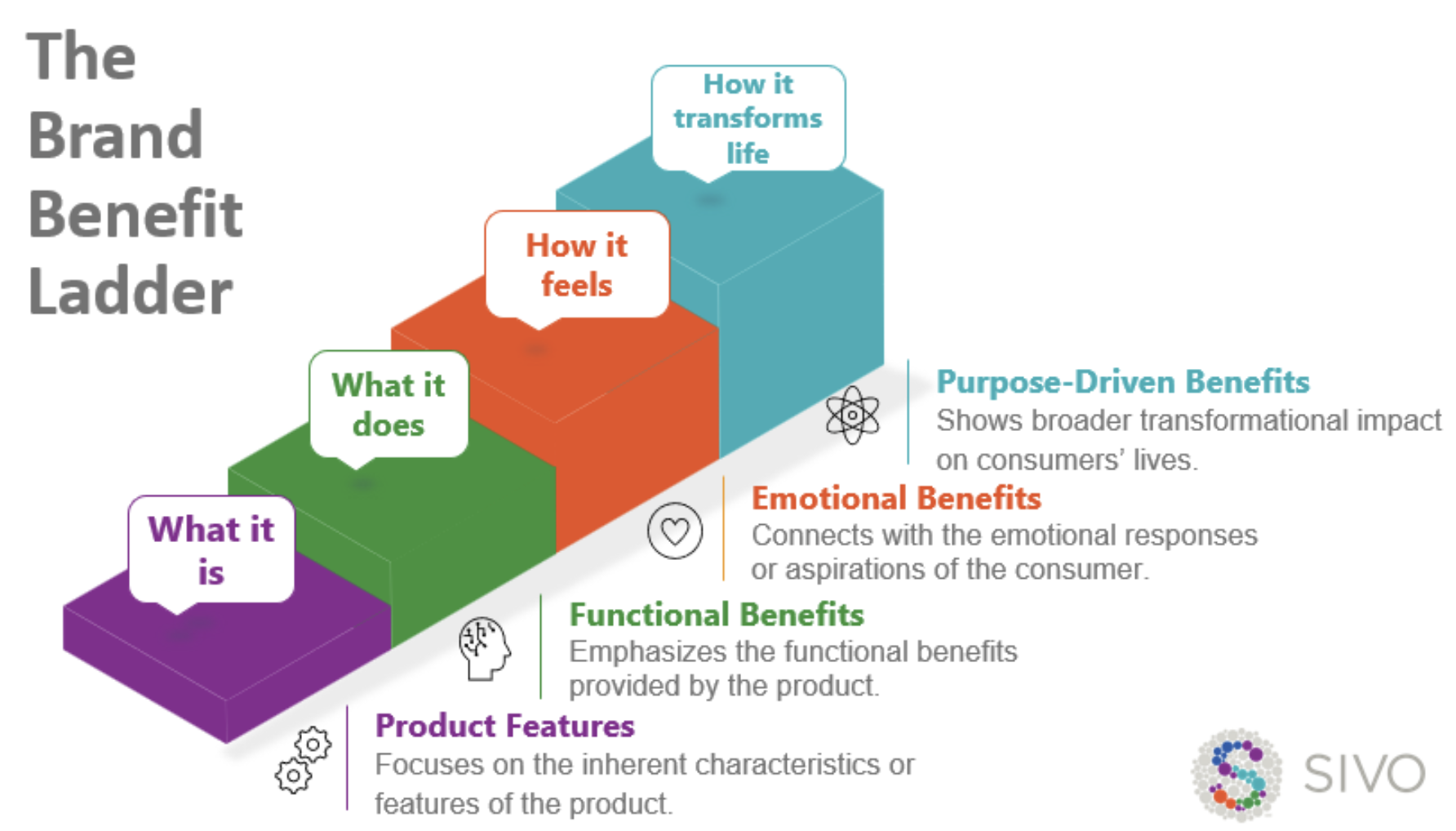
At the heart of developing a strong brand positioning is a solid understanding of the Brand Benefit Ladder, a strategic tool used early in the positioning development process. It helps brand teams articulate the value proposition by identifying benefits at four levels:
1) What it is
2) What it does
3) How it makes you feel
4) How it can transform your life
This framework ensures a clear articulation of the brand’s offerings and the emotional and transformational benefits they provide. Depending on the brand’s maturity and the competitive landscape, positioning can be based on functional benefits (what it is/what it does) or a more emotional/transformational benefits (how it makes me you feel/changes your life).
Positioning Types
There are a variety of positioning types that fit across the Brand Benefit Ladder:
Product Features:
Attribute-Based Positioning centers on specific features that distinguish the product.
Example: For homeowners, Dyson vacuum cleaners are superior carpet cleaners because they offer superior suction, advanced filtration, and allergen removal.
Value-Based Positioning is linked specifically to the price value of the product.
Example: For price-sensitive shoppers, Walmart offers everyday low prices by leveraging its extensive supply chain and scale to provide unbeatable savings on a vast assortment of goods, ensuring customers can save money and live better.
Functional Benefits:
Benefit-based Positioning highlights the key functional benefits or solutions provided by the product.
Example: For fitness enthusiasts struggling to exercise regularly, Peloton is the exercise bike that keeps you motivated to exercise because it delivers an immersive and interactive experience, world-class instructors, and a supportive fitness community.
Problem-Solution Positioning focuses on the problems that the product solves for customers.
Example: For individuals suffering from dandruff, Head & Shoulders provides effective and long-lasting relief from dandruff flakes and itchiness because it has a clinically proven formula that eliminates dandruff, nourishes, and protects the scalp.
Emotional Benefits:
Lifestyle Positioning aligns the product with a particular emotion or feeling.
Example: For athletes and active individuals, Nike enhances athletic performance and empowers athletes to reach their full potential through its innovative, cutting-edge sportswear products.
Cultural Symbolism Positioning uses cultural symbols and references to position the brand within a cultural context.
Example: For motorcycle enthusiasts seeking an authentic and exhilarating riding experience, Harley-Davidson is the iconic motorcycle brand that delivers powerful, custom-made bikes with a rich American heritage and embodying the spirit of freedom, rebellion and individuality.
Purpose-Driven Benefits:
Innovation-led Positioning sets the brand up as a leader in innovation and cutting-edge technology.
Example: For environmentally conscious consumers and tech enthusiasts, Tesla is the leading electric vehicle and clean energy company that offers a sustainable environmental solution via their innovative high-performance electric cars and cutting-edge technology.
Purpose-led Positioning centers on what the brand is doing for the world rather than the product itself.
Example: For socially conscious consumers, TOMS is the footwear brand that provides stylish and comfortable shoes while also making a positive impact on communities around the world though its One-for-One model, where each purchase directly contributes to improving lives in underdeveloped countries.
Purpose-Driven Benefits:
Innovation-led Positioning sets the brand up as a leader in innovation and cutting-edge technology.
Example: For environmentally conscious consumers and tech enthusiasts, Tesla is the leading electric vehicle and clean energy company that offers a sustainable environmental solution via their innovative high-performance electric cars and cutting-edge technology.
Purpose-led Positioning centers on what the brand is doing for the world rather than the product itself.
Example: For socially conscious consumers, TOMS is the footwear brand that provides stylish and comfortable shoes while also making a positive impact on communities around the world though its One-for-One model, where each purchase directly contributes to improving lives in underdeveloped countries.
Regardless of the type of positioning and where it fits on the benefit ladder, all positioning statements need to be clear, credible, and differentiated from the competition. It can then be used to inspire marketing executions across channels, to create consistent communications and connections to the consumer target.
Researching Your Brand Positioning
Developing effective brand positioning requires rigorous research, with the ideal approach being a combination of qualitative and quantitative research.
1. Qualitative Exploration: This phase uses one-on-one in-depth interviews with current and potential consumers to explore brand perceptions and refine positioning language. It helps the client team explore and understand the nuanced emotional and rational drivers behind brand choice and allows the team to modify and improve the positioning statements in real-time, based on consumer input.
2. Quantitative Survey: Once the positioning statements are refined, quantitative research helps identify the most motivating positioning from a handful of alternatives. Surveys and real-world experiments (e.g., testing via digital ads) can be used to test different positioning statements among a larger sample, assessing the impact on brand perception and purchase interest.
By using a combination of qualitative exploration and quantitative validation, brand teams can ensure their positioning is not only compelling but also grounded in consumer reality.
Your Source for Expert Consumer Insights
At SIVO, Inc., we are dedicated to helping our clients develop brand positionings that are clear, unique, credible, and most importantly, relevant to your consumer target. We are trusted advisors in supporting your positioning development and will design custom learning plans that generate the insights needed to carve out a unique space in the market and connect with your consumers. This holistic approach will set the foundation for enduring brand success.
Contact us via our website form or email us at Contact@SIVOInsights.com today to schedule a discovery call!
By Julie Rose
As your fiscal year is coming to a close, new questions and challenges can arise as you finalize spending on this year’s budget:
SIVO Insights On Demand Talent™ Can Help
SIVO’s On Demand Talent is a great solution for Insights Professionals and Teams facing the year-end crunch – with more initiatives than bandwidth to get it all done. We leverage our extensive pool of fractional Insights Talent, with years of experience and expertise, to help you achieve your business objectives.
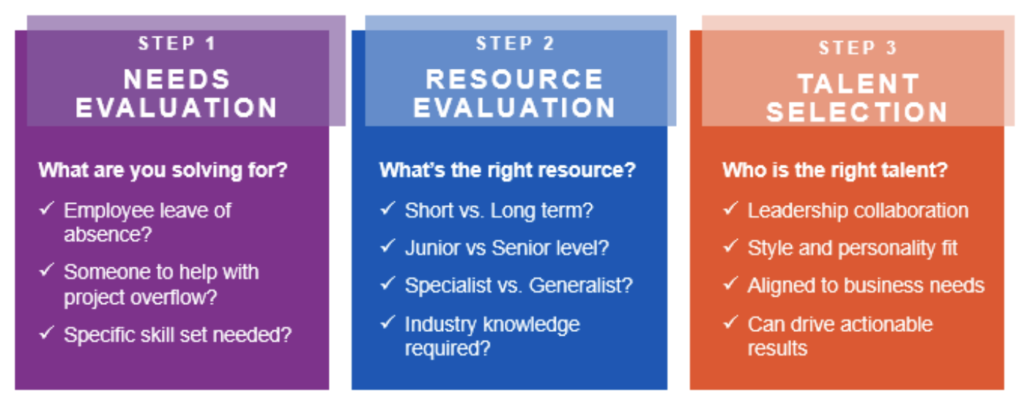
We recommend three key steps for evaluating and making the case internally for hiring contract Insights talent.
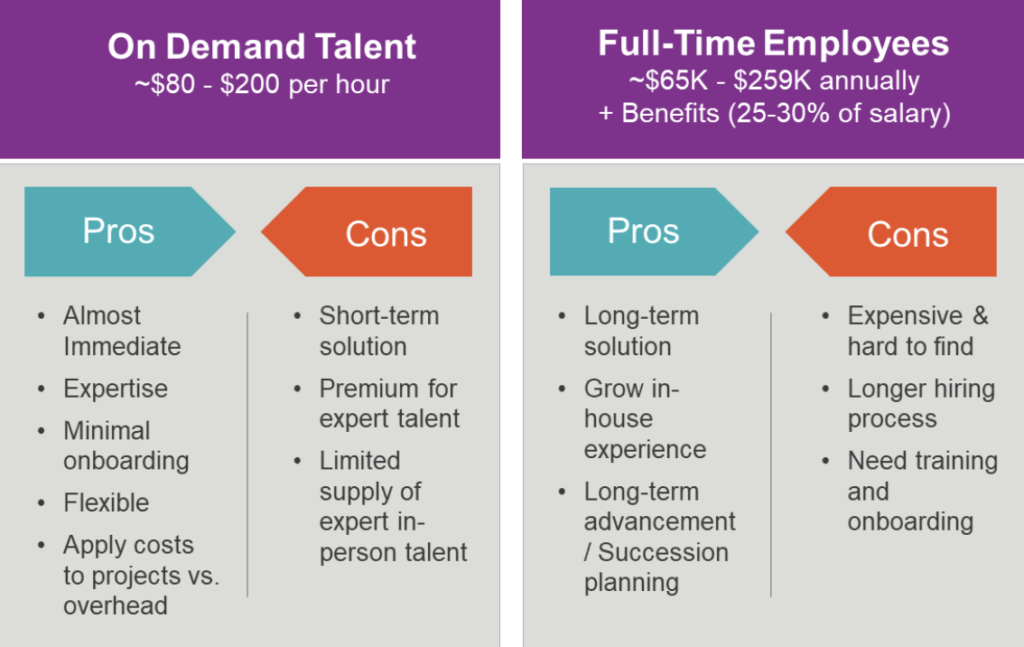
As workforce talent continues to evolve, there is no shortage of options, including interns, short or long-term contractors, contract-to-hire, or direct hire. Below, we highlight the advantages of On Demand Contract Talent vs. a Full-Time Hire:
Prove the Need for Incremental Resources
Some of our clients have struggled to make the case to their leaders for permanent incremental headcount. Instead, they started with SIVO’s On Demand Talent to show value to the business. This step helped them demonstrate the benefit of having additional resources. Let SIVO help you get the additional headcount you need in 2024.
Get Expert Consumer Insights with SIVO
We have started ODT engagements in as fast as one week. To discuss your needs and how we can match the talent with the best expertise for quick solutions in your organization, visit SIVO On Demand Talent or email Contact@SIVOInsights.com.
Through SIVO's "Modern Ways of Working" Mini Chat series, we spoke with innovative consumer insights leader, Jackie Waller, Senior Director of Enterprise Research at The Standard about how to meet the needs of the business while also managing the workload of her Insights team.
One of SIVO's leaders, Brent Budke, connected with Jackie to have a "Mini Chat" about the different strategies she employs, including the SIVO, Inc. On Demand Talent fractional staffing solution, to manage workload surges while leading the market research needs of her growing company.
Check out the entire interview here!
https://www.youtube.com/watch?v=Rz792S-dLW0
Many thanks to Jackie for generously sharing her experience and knowledge with our peers across the Insights industry!
In the world of Insights, it’s vital to align your research projects with business priorities. The SIVO Insights Forum recently hosted author of the book, “More than Just Interesting: How to Build an Insights Function for Impact” and former Ulta Beauty VP of Consumer Insights, Elizabeth Oates, who shared these questions to consider.
1 - How do my potential projects drive the priorities of the business?
2 - Which projects are going to drive future success for the business?
3 - Are there any projects that serve multiple business partners?
https://youtu.be/PZs4uAkRH1I
Tune into a lively on-demand conversation “Bridging The Gap: Translating Insights Into Meaningful Business Results" to hear from Elizabeth and other Insights experts including Eliana Wahnon (General Mills, VP of Consumer & Market Insights) and Khary Campbell (Comcast, VP of Consumer Research & Insights).
Learn from Insights leaders as they discuss:
Thank you to Natasha Weith, VP of Research at SIVO Inc. for hosting The SIVO Insights Forum!
In today’s fast-paced world of AI-powered dashboards, real-time metrics, and instant feedback loops, businesses are flooded with data. But despite this access to information, many teams are still struggling to truly understand their consumers.
Why? Because understanding doesn’t come from data points alone. It comes from empathy – the ability to see the world through your consumers’ eyes.
Empathy is not just a soft skill. In a business context, empathy for your consumer is a strategic asset. And when used intentionally, it becomes a competitive differentiator that can unlock sharper decisions, faster innovation, and stronger brand resonance.
Empathy in a business context goes beyond surface understanding: It’s the process of cognitively and emotionally connecting with your consumers’ experiences, motivations, and needs.
Consumer empathy allows teams to:
And most importantly: it allows your team to move beyond assumptions and act with confidence.
What we see most notably, with the rise of AI, more and more executive teams are pushing for faster, leaner decision-making. But without a connection to real-world consumer behavior, speed risks becoming shallow, and very costly. From an insights perspective, developing empathy within organizations and training teams isn’t a nice-to-have or a luxury – it’s a necessity.
And these are just some examples. Empathy fuels smarter decisions at every level of the business, in all departments.
Whether you’re a CMO rethinking brand positioning or an Insights Director building your learning plans, here are some key tools to bring empathy into strategy:
Spending time in your consumers’ real environments (their homes, their workplace, neighborhood stores, their daily routines, even in their cars) allows you to uncover insights that would never surface in a focus group or controlled environment. Watch for routines, artifacts, interactions, and decision-making moments. What feels normal to them might be revealing for your team.
Ethnographic interviews are perfect to use when exploring new segments, refining product strategy, or understanding how a category fits into everyday life.
Understanding how people actually make choices at shelf (or online) tells you more than any survey can. What stops them? What persuades them? How do they navigate the retail space? How does your product show up relative to your competitors? Shop-Alongs and Path to Purchase Observations are perfect when optimizing in-store experience, packaging, or online conversion strategy.
These immersive, multi-day learning experiences are designed to help teams step into the shoes of their consumers – literally. Whether it’s joining farmers on their land or shadowing a parent on a morning routine, empathy treks bring brand teams (and senior leaders) closer to the emotional context that drives decisions. It’s a common tool to aligning cross-functional teams, inspiring innovation, or uncovering core brand truths.
Mobile mission software, accessed through smart phones, gives you visibility into your consumers’ world in real time or over time. From what they eat and wear to how they talk about brands, these tools capture lived experiences in context, without disrupting them. Digital diaries are perfect for when businesses are looking to understand rituals, routines, and the evolving emotional process of the consumer journey.
Empathy doesn’t end with the research. In fact, it’s only the beginning, and companies should strive to embed it in their day-to-day businesses. But how? That’s where tools like Insight Activation Sessions come in, to help teams translate empathy into action by reframing findings as strategic questions, idea starters, or business moves. A perfect move to embedding insights into planning cycles or cross-functional decision-making, for long-term results.
At SIVO, we love helping clients across industries uncover powerful insights through empathy-driven methods. Here are just a few examples of past cases:
A leading electronics retailer struggled to connect with their consumers – their messaging felt clinical and cold. By stepping into the real lives of their target market, in their own homes, we uncovered the emotional language that truly resonated. The result? Clear direction on positioning and communication strategies – and a renewed path to success in a challenging category.
A global beverage brand was losing relevance across key consumption occasions. Through immersive virtual ethnography, we helped them see how emotions, rituals, and motivations shaped beverage choice across six countries. This empathy-powered understanding led to sharper messaging and inspired marketing activation across core segments.
An electronics brand expanding globally needed to understand what truly drives consumer decisions – but sales data alone weren’t cutting it. Through ethnographic interviews and in-store observations across multiple countries, we uncovered key journey moments that shaped how and why people buy. The insights directly informed their brand growth strategy.
A recreational vehicle company wanted to identify new opportunities for innovation and product improvement efforts – but needed to understand the deeper feelings associated with their utility vehicles. The SIVO and client team spent quality time with farmers and hunters on their properties, riding in their vehicles to see and feel how these vehicles integrated into their consumers’ lives, their farming businesses, and leisure time.
Empathy isn't just a buzzword or about "feeling good" – it's about making better decisions, for you, your company, and your consumers. When you understand the world your consumers live in, you can make decisions with more clarity, alignment, and confidence.
Ready to move from unaware to empathetic?
Let’s explore how empathy can drive better decisions across your company!
SIVO Insights brings together research, talent, and intelligent technology to help organizations navigate complexity with confidence. Have a business challenge? Let's talk!
We bring together research, talent, and intelligent technology to help organizations navigate complexity with confidence