
By Ashton Walz
Are you new to Market Research? Or do you know someone who is new to market research? Many of us came out of business school with no more than one market research class under our belts so that means we had to learn the art and science of market research while on the job. But learning our craft while doing the job can be tricky because you're often "trying to safely fly the airplane while building it." With this in mind, the SIVO team thought it would be great to share the basics of quantitative online survey design with the next generation of market researchers out there. To our experienced clients and friends, please feel free to pass these nuggets on to someone new to our industry!
The Art of the Market Research Survey
An online survey for quantitative market research can be the key to gaining critical insight into your market, consumer, brand, product, or competition. Collecting this valuable data will lead to a better understanding of the market you operate in and your consumers’ preferences, opinions, behaviors, and needs. Leveraging the data and insights gathered from surveys, business teams can make informed decisions, shape their strategies, and refine their products or services.
But collecting this data can be tricky. If the survey is not designed well, organizations can be misled by inaccurate data. Market researchers have a phrase for this…“Garbage in, garbage out.” No one wants to make bad decisions from bad information so here are 10 tips for writing a great market research survey.
10 Tips for Great Online Surveys
Survey development requires both rigor and creativity. It takes experience and practice to get it right but there are some basic rules that will help you garner more accurate results:
1. Define Your Objectives
Clearly establish the purpose and objectives of your survey. Identify the specific information you want to gather and the decisions or actions that will be influenced by the survey results. This should be done first to give your survey questions purpose and direction. A best practice is to categorize your survey questions under each business objective so that when the data is collected, you know that you’ll have the answers you need.
2. Include an Introduction and Instructions
Provide a clear introduction at the beginning of the survey, explaining the purpose, importance, and estimated time for completion. Include instructions for navigating the survey and answering the questions.
3. Ensure Anonymity and Confidentiality
Assure respondents that their answers will remain confidential and anonymous. Avoid collecting personally identifiable information unless necessary for specific research purposes. Be transparent about how you will handle, store and share out the data. This allows the respondent to be comfortable and candid in their responses, which improves accuracy and depth of insight.
4. Avoid Leading or Biased Questions
Frame questions in a neutral manner to avoid biasing the respondents' answers. Use balanced language and avoid leading statements that could influence the respondents' opinions. A survey created with biased questions will ultimately be thrown out as the respondent’s answers are not representative of how they actually feel. An example of a leading question is, “Which product features do you find most useful?” This question assumes that consumers find the product useful when they might not find it useful at all.
5. Provide Response Options
Offer a variety of response options that cover the range of possible answers. Include options like "don't know" or "prefer not to answer" to account for respondents who may not have a specific answer or may be uncomfortable sharing certain information. In doing so, it becomes a lot easier to avoid bad data and get an accurate look at your consumer target’s preferences.
6. Use Logical Flow and Organization
Organize your survey in a logical and coherent order. Start with easy, less intimidating questions to engage respondents and progressively move towards more specific or sensitive topics. By using this ‘funnel’ technique it helps prime the respondent to think more critically when the in-depth questions come up. This organization can also help the researcher to weed out any respondents that would not provide accurate or helpful information for the study. (e.g., if someone doesn’t buy carbonated water, don’t ask them what their favorite flavor is.)
7. Avoid Double-barreled questions
To ensure that your data is clear and insightful, be sure to avoid asking about two topics in a single question as it creates ambiguity in the data and leaves the analyst wondering how to interpret it. For instance, the question, “Please rate how well you like the lighting and atmosphere of this store?” leaves the analyst wondering if the respondent considered the lighting, the atmosphere or both when providing a rating.
8. Make it Interesting
A well-designed market research survey aims to uncover crucial information while simultaneously engaging with the target audience, to cultivate a sense of involvement. A mix of closed and open-ended question types can create a more interactive and enjoyable survey. Not only does it provide for an immersive experience but generally leaves the respondent feeling like they are being heard as they can freely express themselves through various types of questions.
9. Keep Survey Length under 15 minutes
In the same vein as making the survey interesting, survey length should be no longer than 15 minutes and ideally, 12 minutes or less. When respondents get fatigued, it can negatively impact their attention and diligence which impacts data accuracy. Long lengths also lead to incomplete surveys as respondents drop off.
10. Test Your Survey
Before launching the survey, conduct a pilot test with a small group of respondents to identify any confusing or problematic questions. Adjust based on their feedback to ensure clarity and relevance. This can prove to be extremely useful as there could be some things the survey designer didn’t catch that a respondent will.
Your Source for Expert Consumer Insights
At SIVO, Inc., we dedicate ourselves to creating engaging and accurate quantitative market research surveys that help you better understand your market and consumers. We are experts in developing the appropriate questions and applying the right analytic techniques to deliver insights that meet your business objectives.
Contact us via our website form or email us at Contact@SIVOInsights.com today to schedule a discovery call!
By Anna Stoesz, SIVO Insights in partnership with Yogesh Chavda, Y2S Consulting
There is a moment most insights professionals have experienced.
A well-designed research study is presented to a leadership team. The work is solid. The story lands. Heads nod around the room. And then . . . nothing really happens.
Not because the work wasn’t good, but because the learning wasn’t there when the decisions needed to happen. Often when it’s time to decide where to invest, which ideas to back, or how to prioritize markets, people forget about the great learning and quietly drift back to intuition, internal politics or whatever worked last year.
Now we have added AI into the mix. With AI, we talk about auto‑coding open ends, auto‑summarizing interviews, and auto‑drafting reports. We celebrate the time savings; what used to take three weeks now takes three hours. That is certainly progress, but it is not the whole story.
The more exciting shift we’re seeing is that AI can now give us the building blocks to move from episodic research to real-time decision intelligence.
Instead of treating research as a series of projects, we can begin to work in a more continuous way. By monitoring signals, recognizing patterns, and updating our understanding as behavior shifts, we can see opportunities and risks emerge in something close to real time.
In other words, companies are starting to leverage insights from intelligence engines that sit much closer to where decisions are made.
Historically, this kind of decision intelligence was a luxury reserved for companies’ proprietary models and armies of consultants. While AI doesn’t magically answer strategy questions for us, it does make the classic questions of “where should we play” and ‘how will we win” practical for brands that don’t have blue‑chip consulting budgets.
To get there, we must stop thinking about AI as a faster report writer and start thinking in terms of real-time decision intelligence.
This change will also require a shift in how researchers work.
Intelligence engines are focused, AI‑accelerated and human‑guided systems designed to answer specific strategic questions in an ongoing way. In a mature setup, you might see engines that continuously map segments and demand spaces, surface and prioritize need states, and stress‑test ideas against multiple plausible futures. Each engine tackles one slice of the strategy puzzle and together, they form a practical, reusable decision system.
The pattern is always AI + HI (human intelligence), where the human‑led inputs of clear business questions, curated data, and activation meet an AI‑powered engine. The engines are purpose-built, specialized models tuned to a task with guardrails that only come with deep expertise.
To make this concrete, let’s look at a situation common to both B2B and B2C clients.
A mid‑size health and wellness brand had a segmentation built five years earlier. It was still the official truth, but everyone knew it no longer matched reality. New players had entered; behaviors had shifted; the market had fragmented. Both the marketing and innovation teams were eager for refreshed insights as they moved into the annual plans process, which was quickly approaching.
The team considered refreshing the work as originally designed but knew it would require high costs and months of fieldwork and analysis using traditional large-scale surveys and qualitative research that would mean delivering insights too late to act on.
They came to SIVO to understand how an AI intelligence engine might provide the insights they needed to help with real-time learning to support decision-making during the planning process.
We stood up two AI engines: a refreshed dynamic segmentation and a moments engine.
The segmentation engine ingested existing qualitative and quantitative data, ecommerce data, cultural signals, and continuously incorporated new publicly available data through LLMs. It used clustering to surface needs and motivations, reframing them as current demand spaces and segments rather than fixed “personas.”
Because the heavy lift is automated, we could refresh the view as behaviors shifted without launching a new segmentation.
Once we had a sense of the target audience and their needs, the moments engine was then layered on top. It mined deep LLM research, consumer reviews and behavioral data to surface and bring-to-life micro‑moments across the journey.
For this company, the moments turned “we think awareness is the issue” into something sharper:
The team was elated to get the insights during the planning process, when they were ready to build and act on them.
Any time we move AI closer to strategic decisions, the obvious concern is whether the insights are true or not. For this, three guardrails matter:
Traceability - Every output should be traceable to sources, assumptions, and methods. If you cannot show your work, it’s not insight.
Clear Guardrails - Be explicit about what’s in-scope and where extrapolation begins. Most misuses of AI come from over‑generalizing.
Human‑led design, validation and activation - Engines should feed human judgment, not replace it. The value is in how experts design the engines and how teams use the outputs to frame decision and actions.
Human-led validation of outputs and intuition based on actual consumer interaction is also top of mind throughout the process to ensure we have the right inputs and validation to match the level of risk and rigor of the decision.
Once the guardrails are in place, a new consultative playing field opens for insights professionals. The intelligence engines give researchers the ability to play at a more strategic level and not just inform decision-making but truly own the recommendations and “where to go next” conversations.
For earlier-career team members, intelligence engines put “where to play” framing at your fingertips. This makes it easier to step into these types of conversations sooner, whether that is structuring a problem, exploring options, or contributing to decisions in a more meaningful way.
For more experienced leaders, intelligence engines provide a way to continue consulting and building on prior work. They make it possible to explore multiple paths and scenarios, better understand trade-offs, and test how ideas hold up as conditions evolve.
That is the value of moving from episodic insights to real-time decision intelligence. AI intelligence engines enable you to deliver insights confidently, place well-timed bets, and act with precision when it matters most.
This may be a change for researchers who are not accustomed to delivering insight at the point of decision-making, but one with significant opportunity for greater organizational influence and impact.
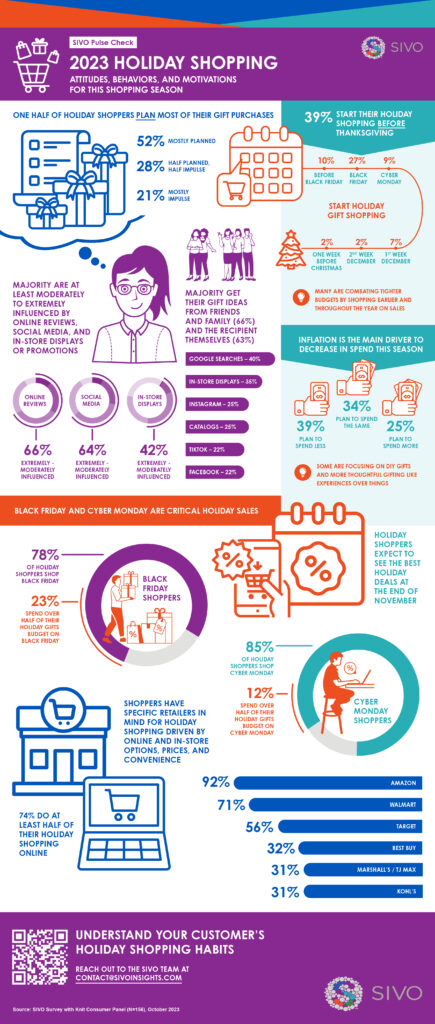
For many manufacturers and retailers, the holiday season can be a “make or break” time period for generating sales and achieving revenue goals. For this reason, it is critical to understand your customer’s holiday shopping attitudes, behaviors and motivations. This is SIVO’s strength. Through approaches like in-store shop-alongs, mobile missions, online communities and in-depth focus groups, SIVO can dig deep into understanding the mindset and behaviors of your target customers, while immersed in the holiday season. Now is the time to act! Let SIVO help you understand your holiday shoppers so you can anticipate their needs and preferences to… Win the Season!
Innovation requires seamless collaboration, agility, and the ability to pivot wisely and effectively. Timelines are tight and the right talent is critical to successfully manage the Insights process. SIVO’s On Demand Talent™ team recently provided a Consumer Insights Innovation Lead for Betsy Frost, Chief Revenue Officer at DRY Soda Company.

DRY Soda needed a Consumer Insights expert to manage the First Moment of Truth (FMOT) consumer learning for a new product launch, DRY Botanical Bitters & Soda, a ready-to-drink non-alcoholic cocktail with zero sugar.
“…it felt like SIVO was a member of our team.”
From the get-go, the SIVO’s talent creatively leveraged DRY Soda’s internal assets and owned social media to recruit the right consumers for quick-turnaround learning. Timelines and budgets were priorities, with no room for missteps. When supply chain complexities forced an immediate change in launch plans, the team worked smartly and effectively to pivot from cans to bottles in a record 15 days. Navigating a plethora of moving parts, including new package design, messaging, team alignment, and consumer feedback demanded an experienced team to pull it off successfully!
During Consumer Research, Frost was thrilled to listen, participate and ultimately make the right real-time decisions from an outside vantage point rather than having to lead and facilitate herself.
Frost said, “You made it super easy and streamlined for me…it felt like SIVO was a member of our team.”
To learn more about the DRY Soda story and line of products available, visit drinkdry. Check out this new product: DRY Botanical Bitters & Soda!
You can Shop Now or click the ‘Find Dry’ link to leverage the unique geo-locator. It allows you to buy online or from the store front retailer of your choice. This shoppable platform is powered by Pear Commerce technology.
SIVO Insights On-Demand Talent provides the right talent for your business needs; it is NOT a one size fits all model. What talent do you need to immediately impact YOUR business? Email Brent Budke to successfully match the right talent.
Are you curious what working differently looks like? – just ask. SIVO Insights can help you figure out the best path forward for you or your company to get the resources – and talent – you need. Schedule a discovery call today to get started.
As 2026 planning season approaches, most leaders are focused on big decisions: where to invest, how to grow, and which bets to place. But the strongest strategies don’t begin with goals, they begin with your consumers.
In fact, the annual planning season is the perfect time to pressure-test assumptions. Before you finalize budgets or commit to growth strategies, it pays to refresh your understanding of today’s consumer landscape. What’s changed? What’s emerging? And what gaps in understanding could derail your decisions?
This post outlines how to approach annual planning through the lens of consumer truth, so you can build smarter, more aligned strategies. Let’s dive in!
For many organizations, planning still begins with internal goal-setting: revenue and profit targets, innovation and growth priorities, and cost cutting. And high-performing teams know that successful strategy isn’t just about setting ambition, it’s about aligning that ambition to current market conditions.
Consumer behavior is one of the most dynamic variables in that equation, and often, one of the most overlooked. Market assumptions that were true a year ago may no longer apply. Purchasing patterns, motivations, and category expectations can shift quickly, especially in volatile economic environments like the current one. And if your plan doesn’t reflect those changes, it’s much more likely to underperform.
This consumer-centric understanding is foundational. It informs product decisions, pricing, messaging, innovation, and channel strategy. Without it, even well-intentioned plans can quickly drift out of sync with real consumer needs. Starting with the consumer also accelerates alignment. It gives cross-functional teams, from marketing to finance to sales, a shared understanding of where the business is heading and why. It moves planning conversations from opinion to evidence and from speculation to strategy.
If the case still isn’t clear, consider this: even well-resourced plans fail when they aren’t aligned with current consumer behavior. It’s often not about effort or execution, it’s about starting with the right inputs. Let’s look at a few examples:
Outdated consumer insights can lead to misdirected efforts, misaligned messaging, missed opportunities, and unnecessary risk. To illustrate what this looks like in practice, here are two common scenarios where strategy easily goes off track because the consumer context was never fully validated.
A company sets aggressive growth targets and decides to compete more directly with newer players in the category. They allocate budget toward developing a new product with features they believe will differentiate them. The plan gets approved. Timelines are set. Everyone is getting ready to mobilize fast and execute.
But the innovation was based on an internal assumption about what consumers wanted – not on recent consumer insight. In reality, consumers weren’t looking for more features. They were looking for simplicity, availability and value. The company spends $$$ getting the launch ready, but the product doesn’t gain any traction. The opportunity for a product refresh was real, but the execution missed the mark because actual buyers weren’t consulted.
Another company, facing margin pressure, looks for quick wins through cost reductions. They make the decision to cut a service element they believe is underutilized, based on operational data and internal team feedback.
What they didn’t realize is that this element was one of the few remaining differentiators in the eyes of their customers. It wasn’t used loudly, but it created trust and loyalty. Cutting it might save money in the short term, but it might erode value perception and reduce retention in the long term.
A brand team, focused on stabilizing performance, decides to stick with the same marketing and channel strategy that had worked well in the past. But in the background, both consumer behavior and category norms had shifted.
Competitors began simplifying their digital experience, consolidating touchpoints, and creating seamless mobile journeys. Meanwhile, this brand was still investing in a fragmented app strategy and outdated content flows. The team didn’t realize that expectations had changed. Consumers weren’t looking for more brand interaction, they were looking for convenience and control in one place. By the time results started to dip, the gap was already visible. A competitive audit or trend review could have flagged these shifts much earlier, giving the brand time to adapt before losing relevance.
These are not unusual cases. They reflect a planning process that moved forward before validating the reality on the ground. Other common issues include planning around outdated needs or occasions, targeting segments that have shifted or declined, or simply prioritizing the things that don’t matter to consumers anyways. None of these decisions are inherently flawed, but when they’re based on outdated or assumed insight, the risk of “planning in the wrong direction” increases.
The good news is you don’t always need to start from scratch. In many cases, the best approach is to audit what you already have, identify gaps, and decide what needs to be refreshed or revalidated.
Here are some key areas worth pressure-testing, before you commit to planning:
Many teams start with a Get Smart session. It’s a fast-turn immersion that pulls together everything you already know, from existing data to partner knowledge to internal POVs, and highlights what’s still missing. These sessions help surface blind spots, align teams, and set the foundation for what to explore further through new research or analysis, which will lay the foundation for a solid and strategic plan.
Insight work at this stage doesn’t need to be complex. It just needs to be focused, current, and relevant to the decisions you’re about to make.
The strongest strategic plans are built on a clear understanding of the consumer. When that understanding is current, relevant, and grounded in reality, teams make better decisions, faster, with less risk, and greater impact. At SIVO, we help businesses enter planning season with confidence:
Whether you need to revalidate consumer segments, understand emerging behaviors, or map new usage occasions, our team designs studies that answer the right questions at the right time. We work fast, focus on what matters to your business, and turn insight into clear recommendations for strategic use you can easily relate to in your annual plans.
Need to align insights and teams quickly? Our Get Smart sessions help you make sense of what you already know and highlight the gaps that matter most. These sessions help build internal alignment early and avoid late pivots, and are perfect as a foundation for your annual plans.
Already have an internal insights team, but planning season is stretching your resources? SIVO’s On Demand Talent gives you access to senior insights professionals who can plug into your team quickly. Whether you need a trends lead, moderator, or strategic storyteller, we match you with the right expert, without hiring delays and long-term commitments. The perfect flexbile insights approach to supercharge your insights team for the planning season!
Consumer truth is the foundation of smarter annual planning. Whether you're building that foundation or scaling your team to deliver it, we're here to help.
SIVO Insights brings together research, talent, and intelligent technology to help organizations navigate complexity with confidence. Have a business challenge? Let's talk!
We bring together research, talent, and intelligent technology to help organizations navigate complexity with confidence