
Be consumer first. Don’t be consumer only. Powerful words by leading Insights executive, Khary Campbell, VP of Consumer Research & Insights at Comcast.
https://youtu.be/xJSQO7VSw5Q
During a recent SIVO Insights Forum, Khary shared the importance of considering the implications of all functions. After all, every function is working in orchestra of the business.
Click here for a lively on-demand conversation “Bridging The Gap: Translating Insights Into Meaningful Business Results" to hear from Khary and other Insights experts including Eliana Whanon (General Mills, VP of Consumer & Market Insights) and Elizabeth Oates (Book Author, and former Ulta Beauty VP of Consumer Insights.)
Learn from Insights leaders as they discuss:
Thank you to Natasha Weith, VP of Research at SIVO Inc. for hosting The SIVO Insights Forum!
By Kerry Juhl
Growth. Every business in the world wants to grow, wants to live their purpose, follow their mission, serve their customers, and make money from it. But sometimes it is hard to know what to do, where to go, to find that growth. We ask ourselves questions like…
Any of these paths could be the right direction for the business but at some point, teams must put a stake in the ground. That said, strategies don’t come out of thin air. It requires an examination of the world in which the business operates.

Teams need to thoroughly examine their:
The output of this examination can be organized into a framework that inspires growth strategies. Growth Frameworks allow teams to reconsider the world in which they operate – literally putting it into a new “Frame” that will help identify issues and unearth opportunities for growth. The opportunities within the framework offer a “where to play” roadmap for teams, allowing them to pick a path forward and define their strategy for growth.
A Proven Process
SIVO has a tried-and-true process for developing growth frameworks that has been refined over the years and across industries. The SIVO team utilizes a specific process, research approach and expert facilitation to lead business teams to a clear and relevant growth framework. The process can be customized to fit the client organization based on factors such as their existing customer knowledge, the team’s availability to participate in the process and team size. Typically, 5 to 10 client team members work collaboratively, guided through five steps, beginning with the discovery of insights that point to future opportunities and ending with an activation plan that will advance the business.

The 5 Steps
MINE
BUILD
APPLY
The Resulting Growth Framework
The output of this comprehensive process is a framework that provides teams with an inspiring construct that has easily digestible, business-relevant content and a common language for client teams to rally around, so they can clearly see and prioritize a path to growth. These frameworks can take many forms, including:
For more definitions and details on each of these frameworks, see SIVO’s Growth Frameworks: A Path to Action & Growth blog.
Applying the Growth Framework
Applying growth frameworks to the business can lead to growth strategies that span across the 4P’s of marketing.

Product strategies could include Innovation to launch new products that fulfill demand or Renovation to improve existing products to better meet customer needs.
Pricing strategies could include Price Increases that strategically align with consumer preferences or Cost Engineering to improve profit margins by removing attributes that consumers don’t value.
Place strategies (i.e., Distribution strategies) could include retailer and channel distribution strategies or category management negotiations to improve product placement that aligns with customer shopping habits.
Promotion strategies could include new advertising campaigns that focus on key benefits that align with what consumers need and value or in-store promotions to align promotional activity with how consumers shop the category.
Reach out to SIVO to learn more about Growth Frameworks
SIVO wants to share our proven process for elevating your insights into a growth framework that enables your team to set strategies that put your business on the path to growth.
Reach out to the SIVO team at Contact@SIVOInsights.com to discuss the approach and growth framework that will be the right strategic fit for your team and your business.
By Kerry Juhl
Our job as Insights Professionals is to not only identify relevant and unique consumer insights but also to apply the information in a way that influences decisions and drives action, resulting in growth. But ensuring that valuable insights are heard, internalized, and acted upon can be a challenge. Personal opinions, competing priorities or lack of focus can muffle the voice of the consumer, and the insights professionals that are trying to share it.
So how do you ensure that the insights you uncover will land with impact and be an enabler for growth?
SIVO has an answer… Growth Frameworks. Along with great storytelling, visually interesting media, and activation workshops, SIVO employs Growth Frameworks to organize insights into an inspiring construct, offering teams easily digestible, business-relevant content and common language for client teams to rally around, so they can clearly see and prioritize a path to growth.
What is a Growth Framework?
A growth framework starts with a deep examination of consumers within a market or occasion, to identify relevant insights. Those insights are then organized into a framework that reveals all possible avenues or opportunities for growth. The opportunities within the framework offer a “where to play” roadmap for teams, allowing them to prioritize opportunities and define their strategy for growth.
Examples of Growth Frameworks
Consumer Jobs/Demand Space Map – Consumer Jobs Maps (a.k.a. Demand Space Maps) help explain why consumers make the choices they make. Consumers use products that help them achieve their goals and meet their needs. In other words, products do “jobs” for consumers. If your product does not effectively do the job, consumers are unlikely to hire it. A Jobs Map becomes a framework to help identify ‘where to play’ and it lives beyond a single initiative. It maps all the jobs that consumers have for a particular occasion. For example, a Snacking Jobs to be Done (JTBD) Map includes all the jobs that consumers have for the snacking occasion. A Financial Investment JTBD Map includes all the jobs that customers have for investing their money. It lives on in your organization as a place to continually go back to for inspiration and focus for innovation, renovation, communication, and brand building efforts.

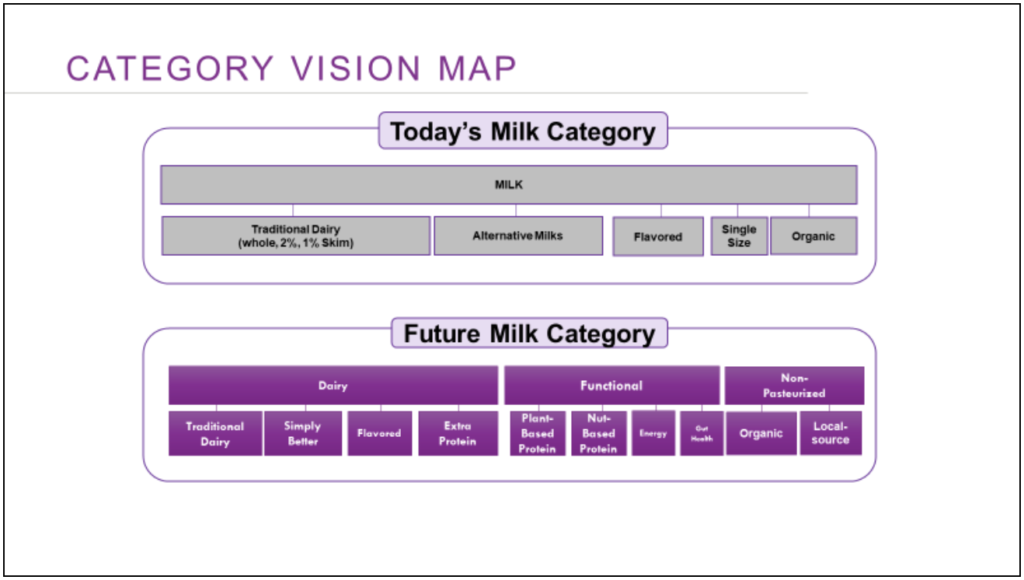
Category Vision Framework – A category vision framework envisions the category of the future. Although no one can predict the future, SIVO, in collaboration with the client team, develops a vision for what the future state of the category will be 3 to 5 years from now. This involves segmenting the existing and new products within a category based on the primary benefit that the products are providing to consumers. Specific attention is focused on new or emerging product lines within the category, and emerging consumer and market trends that may impact the category to identify “signals” for what the future category may look like.
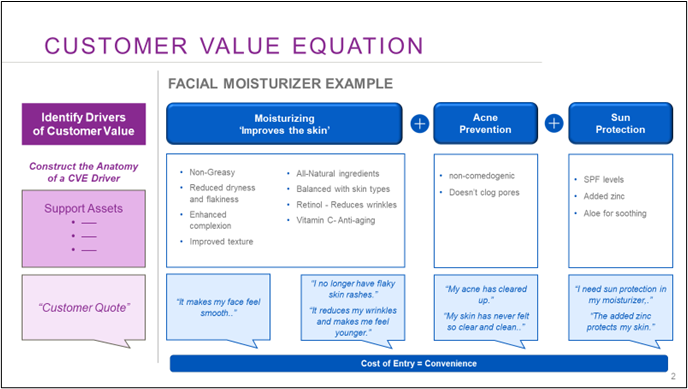
Customer Value Equation – A Customer Value Equation framework provides an understanding of what your customers value about your total brand experience by mapping the key drivers of value and the assets that support those drivers. This framework can guide team decisions on where to invest their next $1 to drive more consumer value or where to cut the next $1 in spending on product attributes that customers do not value. Knowing what drives customer value differentiates and enables companies to stay competitive.
Competitive SWOT – A SWOT (Strengths, Weaknesses, Opportunities, and Threats) framework is a strategic planning tool used by organizations to assess and analyze their current situation and help formulate future strategies. Oftentimes, a SWOT analysis is conducted in reaction to marketplace dynamics, or to proactively prepare for marketplace activities that could happen in the future. For instance, if a competitor acquires a third player in the category or conversely, goes out of business, organizations can develop a SWOT framework to better understand this new reality, and build strategies to respond in a future-focused way.

Benefits of a Growth Framework
Reach out to SIVO to learn more about Growth Frameworks
SIVO wants to help you and your organization elevate your insights into a growth framework that gives you consumer-centric focus, clarity of purpose and galvanizes your team to put you on the path to growth.
Reach out to the SIVO team at Contact@SIVOInsights.com to discuss the growth framework that will be the right strategic fit for your team and your business.
By Cindy Blackstock
We’ve all hired someone to complete a task or a job for us. For example, if your lawn needs to be mowed – you can hire someone to mow it. Seems simple, doesn’t it? But have you ever asked that question about the products or services you work with? Do you know what “job” your customers need done, that is causing them to “hire” your product or service?
Customer needs are often less clear than ‘your lawn needs to be mowed.’ Identifying customer needs or “jobs to be done” is an intentional exercise where we must listen, observe and expertly question customers to uncover.
Jobs Theory reframes our relationship with customers, making them the center of our focus. While conventional marketing tends to focus on brand and product benefits, Jobs Theory doesn't look internally at products and services but instead, looks externally, to expose the functional, social, and emotional jobs that explain why customers make the choices they do.

People don’t simply buy products or services; they bring them into their lives to fulfill a need. We call this need the ‘job’ they are trying to get done. When we discover why customers want to ‘hire’ products or services, we develop a customer-centric view, allowing brand teams to become empathetic to their customers' needs and wants.
Trending for SIVO: What Does a Remote Workforce Really Want? You Need to Dig Deeper to Find Out
A good Jobs to be Done Map becomes a framework that helps marketers figure out how to improve their products or innovate by developing new products and services in their industry or category, i.e., ‘where to play.’ It can be leveraged beyond a single initiative. It maps all the jobs that customers have for a particular occasion. For example, a Snacking JTBD Map includes all the jobs that customers have for the snacking occasion. A Financial Investment JTBD Map, includes all the jobs that customers have for investing their money. It lives on in your organization as a place to continually go back to for inspiration and focus. It provides:

Inspiration and guardrails for brand positioning, marketing messages, product innovation and renovation

A framework for capturing, defining, categorizing, and prioritizing customer needs

A common language and focus for the cross-functional team
There are several factors that influence customer behavior, including:
At SIVO, we help our clients uncover their customers’ jobs for a wide range of application opportunities. We design customized research that leads to a fully developed Jobs to be Done Map. Our approach focuses on uncovering the subconscious drivers of customer decision-making by understanding the underlying needs and true motivations.
In Part 2 of our Jobs series, we will share the keys to success for Jobs to be Done mapping along with some examples of how it comes to life. Until then, please reach out to discuss how we can help you to get your brand, product, or service hired.
Reach out to the SIVO team at Contact@SIVOInsights.com to discuss how we can develop a Jobs to be Done Map for your organization.
By Natasha Weith
Innovation is often seen as a creative pursuit—a way for businesses to stay ahead, differentiate, and drive growth. But for many companies, the innovation process feels uncertain. How do you know if an idea will resonate in the market? Will consumers adopt a new product, behavior, or service? How do you distinguish between a promising concept and a costly misstep?
Most innovation initiatives are guided by internal vision, expert intuition, and trend analysis—all valuable inputs. But in a rapidly shifting consumer landscape, these elements alone aren’t enough.
Too many innovations fail—not because they weren’t good ideas, but because they weren’t validated in the real world before launch. The key to success? Embedding consumer input via market research into every stage of innovation instead of treating it as a final checkpoint.
Companies often assume they “know” their market. Here’s where innovation efforts commonly go wrong:
The result? Companies invest millions in ideas that sound good internally but fail to gain traction.
Consumers don’t just react to new offerings—they make trade-offs based on convenience, price, and habit. A product might be superior on paper, but that doesn’t mean consumers will switch.
To succeed, businesses must:
Without these insights, even a groundbreaking innovation can flop.
The most successful companies don’t just test ideas—they build them alongside the target consumer using agile, iterative research. However, even companies that invest in research get it wrong when they:
✖︎ Use Research as a One-Time final checkpoint – Instead of a continuous input, insights are only used for last-minute validation.
✖︎ Seek Confirmation Instead of Challenge – Teams look for data to support their pre-existing beliefs instead of stress-testing their assumptions.
✖︎ Over-Rely on Stated Consumer Intent – What consumers say they’ll do and what they actually do aren’t always the same.
✖︎ Fail to Connect Insights to Execution – Research reports sit in PowerPoints instead of shaping strategy and launch plans in real-time.
That’s where agile market research comes in. And let’s be clear: Agile research isn’t just about speed – it’s about making sure insights are integrated into the development process and at every decision point. Here’s how:
By embedding agile insights, companies create faster, more successful go-to-market strategies—without unnecessary spend.
It’s easy to get excited about a breakthrough idea. But without rigorous, real-time consumer input, even the most promising innovations can fail.
The best companies don’t just test innovations—they co-develop them with their consumer target. They ensure research isn’t a last-minute formality but a continuous input that sharpens ideas and launch plans and accelerates success.
As you think about your next big move—whether launching a new product, repositioning a brand, or identifying a growth opportunity—ask yourself:
If you’re not fully confident in the answers, it’s time to rethink how market research fits into your innovation strategy.
At SIVO, we help businesses turn market research into a competitive advantage. Whether you're validating early-stage concepts, refining go-to-market strategies, or optimizing post-launch success, we ensure that insights fuel smarter, faster decision-making at every stage of the process.
Our senior insights professionals specialize in agile, in-context research that goes beyond validation to actively shape breakthrough innovations. And with On-Demand Talent, we provide fractional research experts to scale your capabilities—without long-term hiring commitments.
Want to sharpen your innovation strategy? Contact us at Contact@SIVOInsights.com or visit SIVOInsights.com to learn more.
SIVO Insights brings together research, talent, and intelligent technology to help organizations navigate complexity with confidence. Have a business challenge? Let's talk!
We bring together research, talent, and intelligent technology to help organizations navigate complexity with confidence