
By Kerry Juhl
Growth. Every business in the world wants to grow, wants to live their purpose, follow their mission, serve their customers, and make money from it. But sometimes it is hard to know what to do, where to go, to find that growth. We ask ourselves questions like…
Any of these paths could be the right direction for the business but at some point, teams must put a stake in the ground. That said, strategies don’t come out of thin air. It requires an examination of the world in which the business operates.

Teams need to thoroughly examine their:
The output of this examination can be organized into a framework that inspires growth strategies. Growth Frameworks allow teams to reconsider the world in which they operate – literally putting it into a new “Frame” that will help identify issues and unearth opportunities for growth. The opportunities within the framework offer a “where to play” roadmap for teams, allowing them to pick a path forward and define their strategy for growth.
A Proven Process
SIVO has a tried-and-true process for developing growth frameworks that has been refined over the years and across industries. The SIVO team utilizes a specific process, research approach and expert facilitation to lead business teams to a clear and relevant growth framework. The process can be customized to fit the client organization based on factors such as their existing customer knowledge, the team’s availability to participate in the process and team size. Typically, 5 to 10 client team members work collaboratively, guided through five steps, beginning with the discovery of insights that point to future opportunities and ending with an activation plan that will advance the business.

The 5 Steps
MINE
BUILD
APPLY
The Resulting Growth Framework
The output of this comprehensive process is a framework that provides teams with an inspiring construct that has easily digestible, business-relevant content and a common language for client teams to rally around, so they can clearly see and prioritize a path to growth. These frameworks can take many forms, including:
For more definitions and details on each of these frameworks, see SIVO’s Growth Frameworks: A Path to Action & Growth blog.
Applying the Growth Framework
Applying growth frameworks to the business can lead to growth strategies that span across the 4P’s of marketing.

Product strategies could include Innovation to launch new products that fulfill demand or Renovation to improve existing products to better meet customer needs.
Pricing strategies could include Price Increases that strategically align with consumer preferences or Cost Engineering to improve profit margins by removing attributes that consumers don’t value.
Place strategies (i.e., Distribution strategies) could include retailer and channel distribution strategies or category management negotiations to improve product placement that aligns with customer shopping habits.
Promotion strategies could include new advertising campaigns that focus on key benefits that align with what consumers need and value or in-store promotions to align promotional activity with how consumers shop the category.
Reach out to SIVO to learn more about Growth Frameworks
SIVO wants to share our proven process for elevating your insights into a growth framework that enables your team to set strategies that put your business on the path to growth.
Reach out to the SIVO team at Contact@SIVOInsights.com to discuss the approach and growth framework that will be the right strategic fit for your team and your business.
By Natasha Weith
"The great end of knowledge is not knowledge, but action."
- Thomas Henry Huxley
This sentiment resonates deeply in the market research world, where the true value of consumer insights is not in their discovery but in putting them into practice. In fact, one of the defining characteristics of a consumer insight is that it “can be applied to the business in a way that drives growth.”
Too often, valuable market research findings remain confined to lengthy, boring research reports that end up sitting in a file cabinet, collecting dust, and failing to inspire meaningful business actions. At SIVO, we have been thinking a lot about how we and our client teams can make insights land in organizations, inspiring stakeholders to engage in our market research findings and seize the opportunities that we have uncovered. We came up with five strategies to do this.
Here’s how to get insights to land in your organization:
Involving key stakeholders throughout the research journey fosters a sense of ownership and ensures that the insights resonate with colleagues who will act on the insights. Conducting insights activation workshops allows teams to interactively explore findings, brainstorm applications and prioritize the action steps. We also believe “persona immersion sessions” help clients experience the perspectives of their consumers, building empathy and deepening their understanding and commitment to business actions that will serve their consumers.
In addition to engaging the team, securing support from leadership and identifying internal advocates is a great way to influence business outcomes with insights. Sometimes teams employ the “meeting before the meeting” with key leaders to create space for them to think through the implications and ensure linkage between the research findings and organizational priorities. With leadership already on board, the cross-functional teams can feel empowered to act on the findings.
Of course, transforming data into compelling narratives makes insights more relatable and memorable. Employing storytelling frameworks, such as the hero’s journey, can illustrate the consumer's struggle, highlight opportunities, and propose solutions. Utilizing metaphors, analogies, or visual aids like infographics, consumer video reels and photos, further enhances the stickiness of the research findings, ensuring they resonate with audiences. Modifying the report for different audiences can also help, for example, R&D may want a “data-heavy” version while the leadership team will likely want a 3 to 5 slide summary.
To constantly remind teams that their primary role is to serve the consumer and make informed decisions on their behalf, CI teams can proactively “surround” teams with insights. For instance, you can develop and distribute "insight of the week" micro-learning moments through platforms like Slack or MS Teams, to keep teams regularly informed. Additionally, developing consumer reality-check posters for both physical and virtual office spaces can serve as constant visual reminders of the consumer's perspective. Incorporating gamification elements, such as quizzes and contests into standing meetings can further reinforce learning by engaging teams in a dynamic and interactive manner.
These days, CI teams can leverage AI to help with stakeholder engagement in research data and findings. For example, AI-powered dashboards are increasingly available for real-time tracking and scenario planning. Additionally, giving stakeholders access to AI chat tools that query both proprietary research data and public data sources help deliver answers to in-the-moment consumer questions and can increase engagement.
By implementing these five strategies, Insights professionals can bridge the gap between just delivering data and driving organizational change, ensuring that the insights we identify serve as a catalyst for informed decision-making and business growth.
Let’s keep pushing to effectively impact your business together!
SIVO, Inc. is a market research and strategy firm specializing in helping businesses understand people. We partner with world-class brands to answer key questions and identify opportunities that unlock business growth. Our team of insights market research professionals are masters at designing custom research plans, executing with excellence, identifying strategic insights and then helping client teams translate those insights into action. Our On Demand Talent solution places fractional insights experts into client companies to temporarily fill open roles, complete projects or expand team capabilities.
Contact us at Contact@SIVOInsights.com or visit SIVOInsights.com to schedule a Research or On Demand Talent discovery call so we can help you make an impact!
By Leslie Turner – VP, On Demand Talent
Over the past few years, we’ve had the privilege of working with organizations navigating all kinds of change: leadership transitions, unexpected surges in demand, shifting priorities, and the ever-present pressure to do more with less. One consistent theme has emerged: fractional insights talent can be a game-changer.
Not because it replaces full-time researchers. But because it complements them.
We’ve seen fractional researchers step into high-impact roles with speed, empathy, and precision. Whether they are brought in to lead key innovation or brand strategy initiatives, provide Insights leadership or optimize DIY platforms, they can play a key role in helping teams maintain momentum during critical transitions. And they’ve done it all while working alongside internal teams, to stretch their influence and impact.
Fractional insights professionals are seasoned researchers who embed into teams on a flexible, project-based basis. They’re not just temporary workers but strategic partners, who understand the demands of the business. Often former heads of insights or highly experienced research consultants, they bring deep research expertise across methodologies, industries and tools. They work part-time or on-demand, but their contributions are anything but temporary.
"Fractional leadership is the next evolution of the independent contractor economy"
– Sara Daw, Fast Company, July 11, 2025
Marketing research teams are under pressure, with tighter budgets and timelines often competing with higher expectations. It can be hard to anticipate what the next year may bring, and sometimes you just need support now. Fractional talent helps bridge the gap by offering:
They’re especially valuable when your team is trying to scale insights without compromising depth or rigor. We’ve seen them turn raw data into executive-ready outputs, design unbiased surveys, and bring fresh thinking from outside your category, all while working within your existing tools and workflows.
If you’re considering fractional support, here are a few things we’ve learned that help set the stage for success:
Fractional talent isn’t a work-around, it’s a strategic lever. It allows research teams to stay agile, deepen their insights, and build internal capabilities without overextending resources.
Full-time researchers are the backbone of any insights team. Fractional talent simply helps them go further, faster. If your team is thinking about how to balance speed and depth, fractional talent might be the answer.
For further insight into the value of fractional talent and how it could support your team, please reach out. We're always happy to share what we’ve learned, explore your team’s needs, or just talk shop about the future of insights!
What is a Consumer Target
At the foundation of all great marketing initiatives is a complete and deep understanding of the consumer target. The consumer target is a specific and detailed description of the type of person who has needs or desires that you believe can be served or helped with your products or services. Truly identifying and understanding the consumer target can inspire creative and innovative thinking to help grow your brand through new products, marketing campaigns, or promotions that fulfill their needs and wants.
Segmenting the Market to Identify Your Consumer Target
Teams must be focused and clear about who their consumer target is and is not. This consumer does not represent everyone that purchases your product or service.
A typical first step to identifying your consumer target is to segment the market you operate in. Market or consumer segmentation is a market research approach that allows you to divide the universe of potential consumers into smaller groups or segments based on their characteristics. The segments are composed of consumers who will respond similarly to marketing strategies because they have shared demographics, needs, interests, values and/or locations. Once the market has been segmented, an assessment is required to understand which segment of consumers offer the most potential for growth, i.e., which group is most likely to find value and be motivated by your business proposition and respond to your initiatives, across the 4Ps of product, placement, pricing, and promotion.
Building Knowledge About Your Consumer Target
While segmentation is a great first step in identifying your consumer target, it is only the beginning. Every day you will be faced with making business decisions based on what you know about your consumer target and how you think they will respond to your actions. You should have basic knowledge covering five key areas:
Answering these questions requires a combination of sales data analyses, quantitative assessments such as, attitude and usage studies plus, qualitative, or observational techniques such as, in-depth interviews, in-store shop-alongs, and in-home ethnographic research to fully immerse in how your consumer target thinks, lives and shops. Oftentimes, this is referred to as developing the consumer target persona.
Building Consumer Empathy
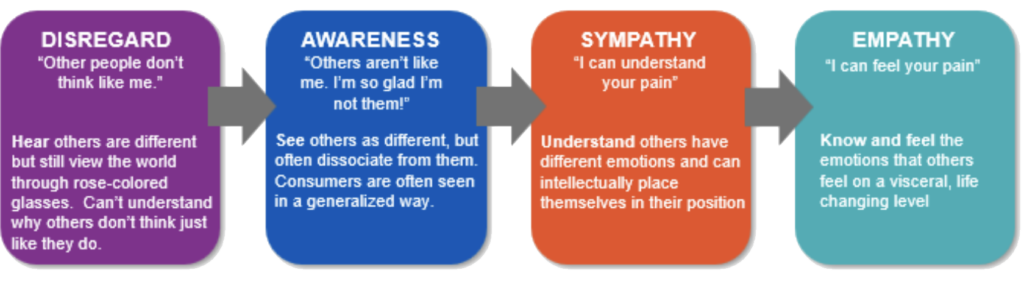
The ultimate goal is to build empathy for and intuition about your consumer target. You need knowledge to understand what is in their head (how they think) and empathy to understand what is in their hearts (how they feel and their underlying motivations). Most of the time, you yourself are not the target consumers so you must spend time with them to truly understand their lives, values, beliefs, and behaviors. The goal should be to move through the following spectrum to be able to genuinely empathize with your consumer target.
How to Get to Empathy for Your Consumer Target
Building empathy is different from conducting a typical market research study. Market research is designed to answer specific business questions by getting feedback and perspective from consumers. For instance, you might conduct market research to understand how your product compares to the competition or what product varieties you should launch next.
An empathy trek is solely designed to gain better understanding of who your consumer target is. It is a listening and observation exercise, designed to help you “walk in their shoes” and “feel what they feel.” In an empathy trek, you’ll explore how your consumer target lives, what they value, believe and how they behave. By building consumer empathy, you will build your intuition about them, and are able to make business decisions on their behalf.
The Value of Truly Knowing Your Consumer Target
The value of building empathy for your consumer target is tremendous. Specifically, it can:
Your Source for Expert Consumer Insights
As you and your team learn more about your consumer, your marketing and innovation ideas will get more targeted at serving their needs, which will in turn, make them more successful. Ideally, you will be able to reach them at key moments of truth, physically or digitally with personalized content that improves the brand experience and loyalty.
At SIVO, we are dedicated to helping our clients identify and understand their consumer target’s perceptions, needs, beliefs, and behaviors. We create learning plans that will help you gain valuable insights by applying the right approaches to identify your market segments, consumer target persona and to build consumer empathy for you and your team.
Contact us via our website form or email us at Contact@SIVOInsights.com today to schedule a discovery call!
As your company is developing and promoting their products and services, it is critical to understand your consumers’ attitudes and behavior to grow the business.
Understanding your consumers require specialized professionals who have the proven market researchtools and best practices. They use a combination of art and scientific methods to gather data regarding consumers’ attitudes, needs, desires and behaviors. So, how do they gather this relevant and meaningful information about the individuals they are seeking to reach and understand more deeply? The answer is Market Research.
Connecting with your consumers and understanding their opinions, needs byutilizing a market research-driven approach can make all the difference in identifying opportunities to build a successful business.
According to Forbes, “Data-driven decision-making (DDDM) is just a fancy term for making intelligent decisions based on what your data is telling you. Modern market research combines DDDM with advanced technology to uncover even more granular data, which can be used to personalize market messaging and find potential areas for growth. Traditionally, market research encompasses four major disciplines: primary, secondary, quantitative and qualitative.”
Primary research gathers first-hand data from consumers. It gives brand teams direct feedback on their services or products from those who are familiar with it or use it. The results are considered conclusive when the data is collected from a representative sample of consumers. Secondary research is when your sources of feedback come from other researchers or second-hand information. This type of market research provides consumer insights by studying trade journal articles, social media conversations, government agency data and published market studies and applying the information to inform business decisions and guide strategies. Together, primary and secondary research can provide more comprehensive and meaningful consumer insights.
Primary research is comprised of both qualitative and quantitative research methods. Qualitative research, which is often exploratory in nature. It captures the in-depth nuances of what consumers say, do, and think by collecting non-numerical data. This could be done through ethnographies, in-depth interviews, focus groups, shopper intercepts, and mobile missions to gather insights that help solve a problem or help you understand your consumers better. Qualitative methodologies focus on obtaining smaller sample sizes so more time can be spent with each consumer. It focuses on the “why” behind consumer opinions, beliefs and behaviors.
Quantitative research is centered on identifying, benchmarking, prioritizing, validating, and translating data into insights that reveal opportunities. Typically, data is collected via online surveys. Quantitative methodologies focus on obtaining larger sample sizes that allow for a higher degree of statistical reliability. This type of research deals with applying statistical analytics to numerical datasets for many business objectives, such as building consumer segmentations, assessing product appeal, understanding the attitude toward and usage of products and services, and mapping consumers’ path-to-purchase journeys.
Both of these research approaches can provide excellent results. It is important to choose the approach that best addresses the business objectives, while taking timing, cost and level of business risk into account.
While primary research provides useful feedback on consumer attitudes and behaviors that can be utilized for developing marketing strategies, there are additional research methods that businesses can leverage to offer teams a holistic view of the consumer.
Brand Sentiment Analysis
Knowing how your brand is perceived by consumers and potential consumers can help you understand the impact of your marketing efforts. . A few factors to look at are consumer awareness, loyalty, advocacy, and value, . Social media monitoring tools are great assets when it comes to measuring consumer sentiment. Studying social media conversations and metrics allow team to identify insights and translate them into actionable strategies. This is a great way to gather unfiltered consumer feedback on your brand.
Understanding your brand sentiment also means knowing how your brand is perceived versus key competitors. It requires selecting the right web conversations to track consumer sentiment for your brand and the competitive brands, to understand strengths, weaknesses, potential threats and opportunities to better compete.
Competitive Intelligence
According to the U.S. Small Business Administration,
“Competitive analysis helps you learn from businesses competing for your potential customers. This is key to defining a competitive edge that creates sustainable revenue. Your competitive analysis should identify your competition by product line or service and market segment.”
Competitive intelligence can support your brand in creating or optimizing marketing campaigns and strategies such as advertising, pricing, and product development and placement. Consider gathering competitive intelligence to get clear on your level of competition and proactively develop relevant actions to compete effectively.
Customer Segmentation
Consumer segmentation is an excellent way to classify customers into specific groups based on their shared characteristics. From here, you can refine your messaging, sales tactics, voice, and tone to connect with these segments of people who are most likely to respond positively to your strategies. This effective approach involves categorizing consumers into different segments, based on their demographics, geographics, behaviors, and psychographics.
The benefit of this market research analytic technique is that consumer segmentation helps businesses devise comprehensive strategies that can help brands attract new customers, retain existing ones, and create brand loyalty across the consumer base.
How Your Business Can Stay Competitive
With technology rapidly increasing and new products and services entering the market daily, it can feel like an uphill battle to stay ahead of the competition. This is why utilizing SIVO’s consumer insight and market intelligence solutions are some of the best decisions you can make for your business. At SIVO, we help you better understand your customers, differentiate from the competition, and develop consistent, consumer-centric products and services by providing your team with actionable insights.
We do this by analyzing market research data that reveals consumer attitudes and behaviors.. This information is turned into actionable insights that result in satisfied consumers, thus higher salesand incremental growth. SIVO will:
SIVO has worked with start-ups to Fortune 500 companies to understand their most essential needs. We then design and execute best-in-class custom market research aligned with your business objectives.
Trust SIVO to Help You Better Understand Your Consumer’s Behavior
SIVO will help you drive your business forward with consumer insights, organizational intelligence, market and competitive intelligence, or on demand talent solutions.
Contact SIVO today to schedule your discovery call.
SIVO Insights brings together research, talent, and intelligent technology to help organizations navigate complexity with confidence. Have a business challenge? Let's talk!
We bring together research, talent, and intelligent technology to help organizations navigate complexity with confidence