By Natasha Weith
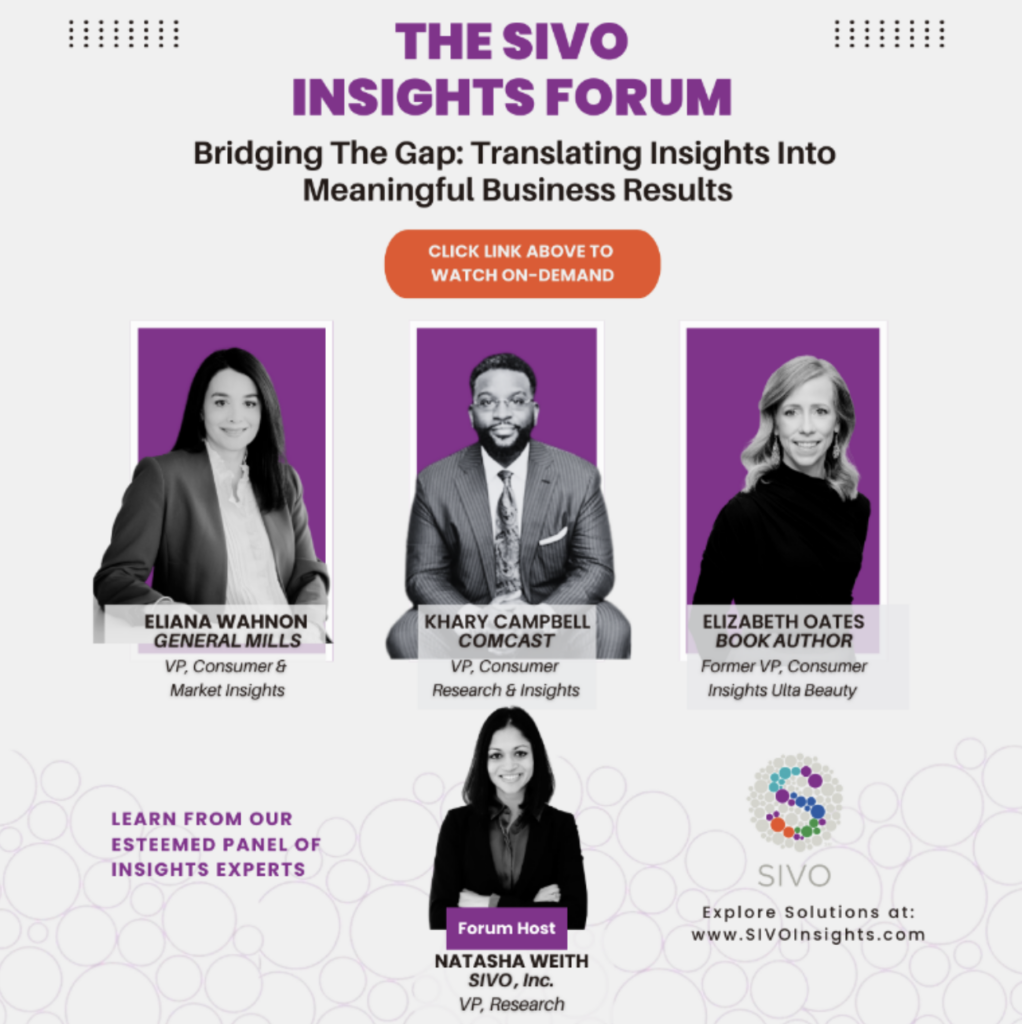
As someone who’s passionate about the power of insights to drive business growth, I was thrilled to host our recent SIVO Insights Forum, “Bridging the Gap: Translating Insights Into Meaningful Business Results.” It was an inspiring conversation with some of the best minds in the insights industry, and I’m excited to share the experience with you.
At SIVO, we believe consumer and marketplace insights are the foundation for business growth. But let’s be honest, while all insights professionals understand this, turning those insights into actionable business strategies can be a real challenge. That’s exactly why we brought together this incredible panel of leaders to share their expertise and experiences.
I had the honor of facilitating this discussion with:
• Eliana Wahnon (VP of Consumer & Market Insights, General Mills)
• Khary Campbell (VP of Consumer Research & Insights, Comcast)
• Elizabeth Oates (Book Author, Former VP of Consumer Insights, Ulta Beauty)
Together, we explored how to bridge the gap between data and meaningful outcomes. Whether you watch the session on-demand (linked here) or continue reading for some highlights, I think you’ll find this forum both interesting and actionable.
Aligning Market Research with Business Priorities
In a world filled with data, the ability to convert that data into actionable insights sets successful businesses apart from the rest. Insights professionals must not only translate data into insights, but also deliver those insights in a way that inspires ideas and guides business strategies.
Insights teams need to be strategic about where they focus their time and resources. More specifically, it is vital to align research projects with business priorities. Elizabeth Oates posed these questions to consider during The SIVO Insights Forum:
Navigating through the business questions and issues that arise and honing in on those with the highest business priority offers the greatest chance of making a meaningful impact with your research findings.
Navigating Leadership Reluctance
One common challenge that Insights teams face is leadership reluctance to act on the research findings. This hesitation may stem from personal biases or not understanding the potential benefits. Forming alliances with key stakeholders and truly understanding the business from their perspectives will help insights teams address real business needs and inspire colleagues to act. This can take the form of getting early buy-in on research objectives and designs or previewing the findings and recommendations with colleagues to ensure alignment with broader organizational goals.
To this point, Khary Campbell advised insights teams to “be consumer first, but not consumer only,” during our panel discussion. “Consider the research implications to all the functions. After all, every function is working in an orchestra to drive business growth.”
Making a Bigger Impact
Insights teams can expand their influence by highlighting the strategic value of their work. Sharing success stories, aligning insights with organizational goals, and fostering a culture of consumer-driven decision making are crucial steps toward amplifying the impact of insights.
Great storytelling with a clear narrative, executive summary, intuitive visual aids and consumer quotes can simplify complex data and enhance understanding. These tactics ensure that research results will grab attention, persuade, and motivate key stakeholders and drive action.
Eliana Wahnon shared a 3C’s framework for driving impact when reporting research results:
The Evolving Role of Insights
The SIVO Insights Forum also gathered perspectives on the rapidly evolving role of insights professionals, inspired by the advancements in AI and the increasing complexity of consumer behavior. Despite suggestions that automation may replace traditional roles, the leaders in the panel believe insights professionals will remain indispensable for managing AI, distinguishing truth, and uncovering the “why” behind consumer actions. As Eliana Wahnon emphasized, “While AI offers tools to streamline tasks like drafting questionnaires and analyzing unstructured data, it cannot replicate the nuanced understanding of human behavior, or the creative spark needed to inspire ideas.”
Elizabeth Oates underscored the importance of balancing historical insights (the rearview mirror) with a forward-looking perspective (the windshield) to navigate future challenges. The discussion highlighted “scenario thinking” as a vital skill for anticipating multiple possibilities in an uncertain world.
Ultimately, AI is a tool to enhance efficiency and free up time for strategic thinking, but the human role in connecting dots, navigating contradictions, and driving innovation remains irreplaceable. As Khary Campbell noted, “Insights professionals must stay curious and adaptable, leveraging technology while preserving the core skills that drive business impact.”
This balance ensures the field of insights not only survives but thrives, enabling businesses to navigate an ever-changing future with clarity and purpose.
Conclusion & The SIVO Insights Forum
As I reflect on the conversations we had during the SIVO Insights Forum, one thing is clear: insights professionals play such a critical role in shaping decisions that drive growth, via consumer insights, but our real challenge lies in ensuring those insights are acted upon.
The panelists shared so many practical strategies and thought-provoking ideas that I believe can truly help us build trust, credibility, and impact within our organizations. From navigating leadership reluctance to making a bigger organizational impact, these insights resonated with me—and I hope they will with you too.
If you want to dive deeper into these topics, I highly recommend watching The SIVO Insights Forum “Bridging The Gap: Translating Insights Into Meaningful Business Results”. You’ll hear directly from our incredible panelists about:
Let’s keep pushing forward, bridging the gap, and making an even bigger impact together.
About SIVO Insights
SIVO, Inc. is a market research and strategy firm specializing in helping businesses understand people. We partner with world-class brands to answer key questions and identify opportunities that unlock business growth. Our team of insights market research professionals are masters at designing custom research plans, executing with excellence, identifying strategic insights and then helping client teams translate those insights into action. Our On Demand Talent solution places fractional insights experts into client companies to temporarily fill open roles, complete projects or expand team capabilities.
Contact us at Contact@SIVOInsights.com or visit SIVOInsights.com to schedule a Research or On Demand Talent discovery call so we can help you make an impact!
Before we experienced a worldwide pandemic and the Great Resignation, employers knew how to keep and retain talent. The focus was on providing work-life balance, exciting roles, improved technology, and better onboarding and training. In this new age, people are requesting flexible work schedules and locations. A report by the Future Forum, a group within Slack Technologies Inc, found that “95% of employees want flexible schedules and 78% want flexible locations.”
While not having to stick to a fixed 9-5 schedule and the ability to work from anywhere can be helpful to workers, employers need to dig deeper to understand how this will play out. These new ways of working come with drawbacks that can sneak up and drag down employee satisfaction and morale.

Because the boundaries aren’t as firm as they once were. We used to have a built-in transition with the commute to and from work. Many of us no longer have that physical and mental transition that ends work time and starts home time.

comes from being online all day, in virtual meetings, without truly interacting or collaborating with people face-to-face. Gone are the spontaneous “water cooler chats” and the conference room banter that happens before and after meetings.

If you find yourself talking to your dog or cat throughout the day, you are not alone. Working from home can create feelings of loneliness and isolation, as people find themselves rarely needing to leave their home/work office. This can be especially true if you started a job during the pandemic and you have never met your co-workers or manager in-person.

Many companies are incorporating new approaches to support employees in adjusting to flexible schedules and locations, such as:
If you haven’t listened to your employees recently, now is the time. We can help you and your organization understand what employees REALLY want, and how to help them achieve the balance they crave in this new world we are navigating.
With SIVO’s Organizational Intelligence Solution, we dig deep via employee interviews and group discussions to understand the challenges and engagement of the workforce. We facilitate leaders in the development of strategies and solutions to help employees cope with the “side effects” that come with flexible work schedules and remote work environments.
Trending
By Natasha Weith
Innovation is often seen as a creative pursuit—a way for businesses to stay ahead, differentiate, and drive growth. But for many companies, the innovation process feels uncertain. How do you know if an idea will resonate in the market? Will consumers adopt a new product, behavior, or service? How do you distinguish between a promising concept and a costly misstep?
Most innovation initiatives are guided by internal vision, expert intuition, and trend analysis—all valuable inputs. But in a rapidly shifting consumer landscape, these elements alone aren’t enough.
Too many innovations fail—not because they weren’t good ideas, but because they weren’t validated in the real world before launch. The key to success? Embedding consumer input via market research into every stage of innovation instead of treating it as a final checkpoint.
Companies often assume they “know” their market. Here’s where innovation efforts commonly go wrong:
The result? Companies invest millions in ideas that sound good internally but fail to gain traction.
Consumers don’t just react to new offerings—they make trade-offs based on convenience, price, and habit. A product might be superior on paper, but that doesn’t mean consumers will switch.
To succeed, businesses must:
Without these insights, even a groundbreaking innovation can flop.
The most successful companies don’t just test ideas—they build them alongside the target consumer using agile, iterative research. However, even companies that invest in research get it wrong when they:
✖︎ Use Research as a One-Time final checkpoint – Instead of a continuous input, insights are only used for last-minute validation.
✖︎ Seek Confirmation Instead of Challenge – Teams look for data to support their pre-existing beliefs instead of stress-testing their assumptions.
✖︎ Over-Rely on Stated Consumer Intent – What consumers say they’ll do and what they actually do aren’t always the same.
✖︎ Fail to Connect Insights to Execution – Research reports sit in PowerPoints instead of shaping strategy and launch plans in real-time.
That’s where agile market research comes in. And let’s be clear: Agile research isn’t just about speed – it’s about making sure insights are integrated into the development process and at every decision point. Here’s how:
By embedding agile insights, companies create faster, more successful go-to-market strategies—without unnecessary spend.
It’s easy to get excited about a breakthrough idea. But without rigorous, real-time consumer input, even the most promising innovations can fail.
The best companies don’t just test innovations—they co-develop them with their consumer target. They ensure research isn’t a last-minute formality but a continuous input that sharpens ideas and launch plans and accelerates success.
As you think about your next big move—whether launching a new product, repositioning a brand, or identifying a growth opportunity—ask yourself:
If you’re not fully confident in the answers, it’s time to rethink how market research fits into your innovation strategy.
At SIVO, we help businesses turn market research into a competitive advantage. Whether you're validating early-stage concepts, refining go-to-market strategies, or optimizing post-launch success, we ensure that insights fuel smarter, faster decision-making at every stage of the process.
Our senior insights professionals specialize in agile, in-context research that goes beyond validation to actively shape breakthrough innovations. And with On-Demand Talent, we provide fractional research experts to scale your capabilities—without long-term hiring commitments.
Want to sharpen your innovation strategy? Contact us at Contact@SIVOInsights.com or visit SIVOInsights.com to learn more.
Across industries, brands attempt to access and leverage data to unlock stronger sales and business growth. Your team can bring a wealth of experience and expertise to initiatives, but getting feedback from the people who engage with the product produces better outcomes. Below, we’ll answer the questions: what are consumer insights? Why are consumer insights important? And What is the best way to get consumer insights for my business?
First thing’s first, what are consumer insights? Consumer insights are the underlying motivations or needs that make a consumer behave a certain way. Insights professionals work to understand consumer attitudes, requirements, desires and behaviors to uncover insights that can then guide brand building, portfolio and marketing communications efforts. Many organizations gather data from their consumers, but the real depth of insight comes in asking the right questions and getting the full picture from consumers. Insights gleaned from studying and connecting with your consumers can inform nearly every aspect of your business’ path to growth.
So, how do you get consumer insights? Businesses can get consumer insights in several ways. The correct method for your team depends largely the business question, as well as the industry and market you serve. For example, organizations may capture qualitative data via focus groups, in-depth interviews, and user immersions to identify the nuances in consumer values and opinions.
Meanwhile, quantitative data like path-to-purchase, product testing, and volumetric forecasting can help teams validate consumer interest and behaviors and build confidence in decision-making and actions. Consumer insights experts can gather this information in a number of ways. See some of the most effective consumer insight solutions and techniques below:
Qualitative Consumer Insights
Ethnographies
In-Depth Interviews
Focus Groups
Shopalongs
Shopper Intercepts
Mobile Missions
Online Bulletin Boards
Fishbowls
Agile Sprints
Rapid Refinement
Communication Checks
User Immersions
In-Home Usage
Interactive User Experience
Jobs to Be Done
Quantitative Consumer Insights
Segmentation
Attitude and Usage
Path-to-Purchase
Tracking Testing / Screening
Brand Positioning
Brand Architecture
Product Testing
Creative Testing
Opinion Polling
Now that we know what they are, why are consumer insights important? Essentially, consumer insights remove some of the speculation from your business decisions and actions. It provides actionable answers to what consumers think about your brand, your category, and your products or services. Once you receive those insights, you can take it and run. It’s the fuel that ignites new product or service innovation and optimization, brand experiences and communications. At a higher level, it gives your business access to an entirely new perspective within your consumer market. Consumer insights give you a more holistic understanding of the consumer target audience you want to connect with, allowing you to gain a competitive edge within your industry.
So, why is consumer insight important? There are several reasons growing brands invest in these solutions to drive growth and gain a competitive edge. See why more and more businesses focus on obtaining consumer insights for their strategies below:
The best business strategies have data-backed insights behind them. Consumer insights allow you to identify a “why” to inform and support your business initiatives. The same goes for your brand.
Understanding what people truly believe about your brand can transform marketing strategies. Today, it is important to know who your customers are, what they do, what they value, and why it matters. The best way to answer those questions is to identify your consumers and start a dialogue to better understand them. This dialogue and the insights that come from it allows your business to bring more value to the people you serve. It all leads to better customer experiences and a stronger return on investment.

Every product or service has areas for improvement. Who are the best people to provide that feedback? The individuals who purchase and use them. Getting honest opinions on your current portfolio helps you identify the best places for optimization. You can spot holes in the market and create solutions that fill consumers' unmet needs. Some of the best product ideas and business innovation can come straight from your customers.
It all starts with empathy. Providing enhanced, consumer-focused products and services can only benefit brand loyalty. Brands need to continuously check in with their customers to ensure they have positive brand experiences and identify new ways to delight them. As mentioned above, your products/services can consistently improve to meet the needs of your customer base. Ultimately, this all works toward a stronger relationship with your audience to gain ongoing loyalty. That goes a long way when they are choosing between brands.
How can consumer insights fuel your marketing campaign? Speaking directly to your target audience members creates more nuance and specificity in your consumer-first marketing campaigns. Every engagement in your advertising and beyond should prioritize your consumer. Understanding their values and preferences deeply allows you to speak to them more directly and effectively. If you’re on the journey of building your brand or audience-based marketing (AMB) strategy, these insights provide a path toward successful campaigns that move the needle and influence consumer behavior.

What is your customer’s experience with your brand? Are there features that they like or dislike? Sometimes small things go unseen by marketers, but small details can leave a lasting impression on consumers. Whether it’s digital user journeys, messaging, or customer service conversations, it’s invaluable to hear, understand and react to what people think when they engage with your brand, products, and representatives.
If your organization is wondering how to get consumer insights, the best path is through a specialized consumer insights company. SIVO is a global insights and strategy firm specializing in understanding people and their needs and beliefs that drive behavior. We partner with brands to answer key questions that guide strategies and fuel growth. First, we schedule a discovery meeting, where we ask your stakeholders and subject matter experts key questions about your business and needs. Then, we design a custom research approach that aligns with those requirements. From the data gathered, we identify key insights that inform your decisions and drive business growth. Our experts act as your ongoing partner, helping you access your consumers and interpret the research every step of the way.
Ready to get meaningful consumer insights to unlock your next business and brand strategy? SIVO provides full-service custom consumer research and experiences for business across industries. Whether you need consumer insights, organizational intelligence, market and competitive intelligence, or on-demand talent, we empower organizations to get the most of their business, marketing, and brand building efforts to better achieve their goals. Contact SIVO today to get started.
By Kerry Juhl
Fast changing marketplace dynamics and consumer behavior tied to the recessionary economy are putting businesses at a crossroads. Teams need to quickly assess their priorities and pivot to new revenue and profit growth strategies. But in times of upheaval, the activities of teams can take over and they run the risk of confusing activity for progress. The alignment gained by pausing and reflecting as a team can keep the momentum going on key priorities while letting go of the rest.
An important step amidst a consumer learning initiative is to reflect, assess, and decide on next steps. It can happen in-person or virtually and can take as little as 60-90 minutes of the team’s valuable time. For this critical step in the journey, an outside, unbiased facilitator can be your most powerful tool.
There is no better time than now to consider these top 5 benefits of engaging a professional facilitator:
1. Unbiased Professional
A trained facilitator brings the valuable benefit of being an objective leader who can listen to all points of view, not vested in a particular position or outcome. This creates the conditions for a more open dialogue and opportunity to see possibilities that otherwise may be missed.
2. Participate in the Discussion
Ask yourself where you can add the most value. Should you try to participate and facilitate or focus 100% on participating with your team? Engaging a trained facilitator does a couple of things. It sends a message that this work is important. It also allows you, the owner, to invest your energy into the discussion while allowing an expert facilitator to customize the process and tools around your needs and objectives.
3. Full Engagement
Critical to success is hearing from everyone in the group. This can be tricky, particularly if there are strong (or silent) opinions and voices, and now you are not in the same room! Facilitators are skilled at navigating the group dynamics and engaging all participants into the discussion to ensure each voice is heard. They also know how to keep the ideas flowing when the group might get stuck.
4. Stretch Thinking
One of the most valuable benefits of a trained facilitator is the ability to stretch the group’s thinking. They are experts at quickly capturing ideas, summarizing, asking the right questions to build on ideas, connecting the dots between ideas, and pushing participants to think outside the box.
5. Drive to Solutions
With a process designed to meet the objective, the facilitator continually uses techniques to ensure a successful outcome with clear next steps, accountability and buy-in from the group.
Through the stages of Immersion, Interaction and Ideation, we help our clients gain empathy and develop the strategies and alignment needed to boost momentum and forward progress toward the team’s goal. Please contact Kerry.Juhl@SIVOInsights.com to learn how we can customize an approach with the right professional facilitator to meet your needs. We have a team of seasoned professionals who are passionate about working with like-minded clients and would love to talk to you!
SIVO Insights brings together research, talent, and intelligent technology to help organizations navigate complexity with confidence. Have a business challenge? Let's talk!
We bring together research, talent, and intelligent technology to help organizations navigate complexity with confidence