
Before we experienced a worldwide pandemic and the Great Resignation, employers knew how to keep and retain talent. The focus was on providing work-life balance, exciting roles, improved technology, and better onboarding and training. In this new age, people are requesting flexible work schedules and locations. A report by the Future Forum, a group within Slack Technologies Inc, found that “95% of employees want flexible schedules and 78% want flexible locations.”
While not having to stick to a fixed 9-5 schedule and the ability to work from anywhere can be helpful to workers, employers need to dig deeper to understand how this will play out. These new ways of working come with drawbacks that can sneak up and drag down employee satisfaction and morale.

Because the boundaries aren’t as firm as they once were. We used to have a built-in transition with the commute to and from work. Many of us no longer have that physical and mental transition that ends work time and starts home time.

comes from being online all day, in virtual meetings, without truly interacting or collaborating with people face-to-face. Gone are the spontaneous “water cooler chats” and the conference room banter that happens before and after meetings.

If you find yourself talking to your dog or cat throughout the day, you are not alone. Working from home can create feelings of loneliness and isolation, as people find themselves rarely needing to leave their home/work office. This can be especially true if you started a job during the pandemic and you have never met your co-workers or manager in-person.

Many companies are incorporating new approaches to support employees in adjusting to flexible schedules and locations, such as:
If you haven’t listened to your employees recently, now is the time. We can help you and your organization understand what employees REALLY want, and how to help them achieve the balance they crave in this new world we are navigating.
With SIVO’s Organizational Intelligence Solution, we dig deep via employee interviews and group discussions to understand the challenges and engagement of the workforce. We facilitate leaders in the development of strategies and solutions to help employees cope with the “side effects” that come with flexible work schedules and remote work environments.
Trending
By Kerry Juhl
Do you know how your customers feel about their experience with your brand? Do they love it, or does it leave them feeling frustrated?
If your customers don’t love their experience with your products or services, your market share is likely at risk. According to a study from PWC,
Even if people love your company or product, in the U.S., 59% will walk away after several bad experiences, 17% after just one bad experience.
You cannot afford to not know how your customers are experiencing your brand.
The Importance of your Customers’ Experience (CX)
Understanding your customers’ experience can identify product or service flaws. It can be important, even if you are coming from a place of strength. It allows you to build stronger customer relationships, seize new growth opportunities, and maintain a competitive edge in the market. Companies that prioritize a strong understanding of the customer experience are better positioned to meet the needs of their customers where they are and how they want to be served. This allows companies to thrive in today’s customer-centric business environment
Typical Stages in a Customer Journey
The customer journey is typically divided into sequential stages that represent the key phases of the customer’s interaction with the brand. Stages typically align with the marketing funnel and include “Awareness,” “Consideration,” “Purchase,” “Retention” and “Advocacy.” These stages may differ, depending on the industry, category, or channels that the brand is competing in.

What is a Customer Experienced Journey Map?
A customer experience (CX) journey map is a visual illustration that outlines the steps a customer takes when interacting with a company, brand or specific products or services. It helps organizations gain a deep understanding of the customer’s experience, including their motivations, decision moments, delights, pain points, and emotions that come into play, across all the touchpoints with a brand. Companies may also map the customer journey for competing brands to better understand product strengths and opportunities in a competitive context.

Understanding the Experience
Building a customer journey map requires comprehensive qualitative research exploration and is often followed by quantitative validation. CX Insights Experts start with a combination of observation and qualitative methodologies (e.g., mobile missions, bulletin boards, shop-alongs, in-home visits) to facilitate in-depth conversations with brand or category users. This allows them to delve deeply into each key milestone and brand touchpoint within the customer journey. With the qualitative exploration completed, experts will often conduct an online quantitative survey to validate the journey and quantify the consumer experience with statistically significant sample sizes. Note that the journey may differ for various user segments (e.g., younger vs. older customers, multicultural customers, households with kids vs. no kids, etc.) so the research must be inclusive of customer groups that are important to the business.
Activation Planning with a CX Journey Map
Once the CX Journey Map is complete, it is time to bring the team together to immerse and align on the learning and develop an activation plan. SIVO recommends a 1-day workshop with key team members and stakeholders to:
A Key Asset to Customer Journey Mapping
Hiring a strategic market research agency with proven CX experience, or a fractional Customer Experience (CX) Insights professional to lead the journey mapping process will set you up for success. You will need experts who have a strong background in CX research design, journey mapping, research execution and activation planning. They will help your team:
Contact SIVO, Inc. at Contact@SIVOInsights.com to discuss how SIVO can help you map your customer experience. Also, check out SIVO’s On Demand Talent Profiles to learn more about how a fractional Customer Experience (CX) Insights Manager can be an asset to you and your team.
To Know Thyself is the Beginning of All Wisdom [Aristotle]… and as it turns out, it’s also the beginning of your Brand Strategy
At SIVO Insights, we spend a lot of time helping our clients understand who their consumers are, what they need and why. It is just as important to help our clients understand the competitive context within which they operate, to understand where and how their brands can differentiate and create an ownable competitive advantage.
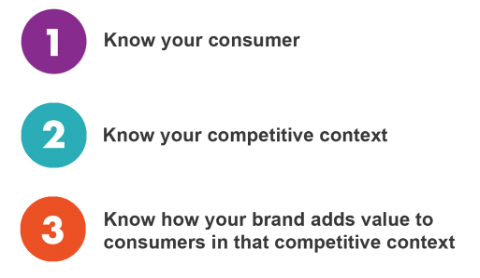
We work with our clients using a three-pronged approach to set a solid brand strategy:
A simple exercise that teams can use to consider and articulate the market that their brand best competes in, is the “Big Box, Little Box” Model.

In this model, teams define the market, or “Little Box” that they believe their brand currently operates in, and what benefits they distinctly deliver to that market. Next, the team considers a broader market definition, the “Big Box”, to understand who is in the brand’s expanded list of competitors and what benefits their product could distinctly deliver in that broader context. By doing this exercise, the team broadens their view of who they are truly competing with and where they can source volume. This helps teams reframe how they present their brand and its ownable benefits to the world. i.e., the brand positioning, which in turn, impacts future renovation, innovation, and communication efforts.
Trending
Do customers want to ‘hire’ your product?
A team that manages a coffee brand might define their “Little Box” as the Coffee category. In that competitive context, the team will likely focus on functional coffee benefits such as richest flavor or best price, to compete with other coffee brands. But when they broadened their view of the competitive context to the “Big Box”, they might find that they are competing with the broader ‘caffeinated beverage’ market. In this context, the key benefits that the team may focus on to differentiate and compete with caffeinated sodas and energy drinks would be things like “warmth, comfort, and enabling your morning ritual.”
The big box, little box model allows teams to…
Discover who they are truly competing with
Reframe their brand strengths within the broader, and likely more accurate, competitive context
Identify which brand benefits are most ownable and distinctive vs. the competitive set
Reconsider who their target consumer is and how to position the brand to meet the needs of this larger consumer target group
Our experts can…
Facilitate a Big Box/Little Box exercise with your team
Execute a qualitative exploration to understand where your brand truly competes
Execute an Attitude and Usage (A&U) study to quantify which competitive products/categories are true competitors
Facilitate a workshop, using the learning above, to rethink and redefine brand strategy
Contact us at Contact@SIVOInsights.com for more information and next steps.
By Kerry Juhl
Managing a business is non-stop, full-time leadership. Typically, 90% of a leader's workday is focused on the daily needs of employees, customers, supply chain, marketing, sales, financials... and the list goes on. However, it is also a leader's job to present their team with a vision for the future, a "north star" that provides direction and goals for the organization, allowing them to compete effectively and transform opportunities into growth.
A great step in looking toward the future is to take stock of the landscape that you operate within, especially when there are changing dynamics in the external environment. The future growth of your business requires you to have a point of view on how your business will be impacted by changing consumer behaviors and preferences, the actions of your competitive set and external partners, and possibly the impact of new technologies. In other words, you need to have a vision of what your category/industry will look like in 5+ years to remain relevant in that future state and capitalize on future growth opportunities.
Trending
Do customers want to ‘hire’ your product?
Our team at SIVO has experience with helping clients build their category vision of the future. In fact, we have developed a step-by-step process that results in a defined Future-State Category Map to inform the Category Vision and Key Strategies for growth. A Category Vision not only demonstrates category leadership and anticipates the future, but it allows clients to take control and literally create their own destiny…a future where the business can thrive.

Define Current State:
Clients need to define the space that they currently play in. For some it might be narrow, for example, Skin Care. For others it might be broad, for example, Beauty Products. (There are pros and cons for how narrow or broad your category definition is and SIVO can guide your team to get to a definition that is relevant and actionable through our consumer insights solutions).
This step requires the gathering of category, competitive and consumer intelligence from a variety of sources, to answer questions, like:
Articulate Future State:
SIVO facilitates the client team through a small series of assignments and working sessions to envision the Future State of the category and to prioritize where to “place bets” within the category to maximize growth.
Create a Vision & Strategies to build Future State:
With the future state of the category defined, SIVO facilitates client teams through the creation of a Category Vision that serves as the "North Star", and Growth Strategies that the organization can put into action to drive category and brand growth for years to come.
A solid process with proven success. Are you ready to help your business create a category vision for the future? Schedule a discovery call today or reach out at Contact@SIVOInsights.com to develop strategies and plans that not only anticipate the future but create it!
by Julie Rose
I’ve been in the workforce for over 30 years (GASP!). I’ve witnessed and been part of a lot of change. Changing technology is a mainstay in the Age of Information, which is centered on accessing information and knowledge easily and quickly. Artificial Intelligence (AI) and machine learning is another advancement in getting that knowledge even faster and more quickly.
With each advancement or new tool, there is the inevitable talk of our jobs going away because the latest advancement is expected to replace us. In many cases, with advancement in technology, there are shifts that do render obsolescence. From my experience, it is the past technologies, not people, that have become obsolete. As people, we adjust, we leverage, we apply critical thinking, we learn, and take advantage of technological advancements to be more effective and efficient but we typically are not replaced.
Experience with Workplace Technological Advances
Early in my career, I was on the Email Task Force when email was just being introduced in the workplace. We grappled with tough topics, like were we going to allow employees to send personal emails. Yes, this is a true story! Email technology has made information flow much faster and easier. In fact, I don’t remember the last time I faxed something to someone. Email improved the way I work, but it didn’t replace me or make my job obsolete.
I also remember leading a team that was evaluating social media listening techniques and tools as we were trying to glean insights from the vast number of online conversations and content. People wondered if we would ever need to conduct primary market research again. People wondered if they would be replaced with Do-It-Yourself Digital scraping tools. It didn’t happen. I’m still here providing custom insights by leveraging the best market research tools to meet my clients’ business objectives.

The Soup-Starter, Not the Soup
The latest advancements in Artificial Intelligence have impacted every industry, and we are all evaluating it to figure out how to safely leverage it and integrate it into our current best practices. My reflection on the many changes I’ve personally experienced has helped me to formulate my thoughts on it. I’ve been asked quite a lot recently by friends, colleagues, and clients what do I think about AI, machine learning, and specifically natural language AI like ChatGPT or Google’s BERT. My latest answer . . . It’s the Soup-Starter, but it’s not the Soup (or the Chef!).
New tools like, ChatGPT, are an excellent way to access information and knowledge quickly and to easily get started on a topic or approach. It starts the soup, but it doesn’t finish the meal. Just like soup needs a chef, research needs a researcher, and insights require an Insights Professional. It takes discernment, creativity, experience, and nuanced choices to make a delicious, complex, flavorful pot of soup and the same goes for a custom market research study. Just like the chef might consider certain stocks and spices to start the soup, a researcher can start with ChatGPT to contemplate potential objectives, methodologies or questions before designing a custom market research project that fully meets the needs of the business.
Using ChatGPT in Market Research
When it comes to market research, we at SIVO have found ChatGPT and other AI tools to be a useful starting point in the following ways:
Evolve toward the Future
As AI technology evolves, we will evolve with it. We will leverage it to improve how we operate. For now, it becomes our new “soup starter” but we still own the recipe and must make the soup. All of us need to experiment and decide how AI can improve our ways of working but we will continue to apply our craftsmanship, critical thinking, and intuition to finish the job.
At SIVO, we are dedicated to understanding your business challenges and questions and will then use our expertise, resources, and access to technology to recommend a learning plan and approach that considers all variables and delivers on your needs. Contact us at Contact@SIVOInsights.com or go to SIVOInsights.com today to schedule a discovery call and connect!
SIVO Insights brings together research, talent, and intelligent technology to help organizations navigate complexity with confidence. Have a business challenge? Let's talk!
We bring together research, talent, and intelligent technology to help organizations navigate complexity with confidence