By Kerry Juhl
The Responsibility & Privilege of Serving Customers
“A customer is the most important visitor on our premises. He is not dependent on us. We are dependent on him. He is not an interruption of our work. He is the purpose of it. He is not an outsider to our business. He is part of it. We are not doing him a favor by serving him. He is doing us a favor by giving us the opportunity to do so.”
– Mahatma Gandhi, 1890
This quote is more than 100-years old, but it is still true today. The opportunity to serve customers is a privilege. The responsibility of that privilege is ensuring the customer’s voice is heard and understood. Brand teams need to know what their customers need and what they value, as decisions about products and services are made on the customers’ behalf.
Defining Customer Value
Understanding customer value can be a differentiator for companies in today’s challenging market. Simplistically, if a brand team has $1 to invest – or needs to cut $1 in spending – knowledge about what customers’ value must guide these business decisions to stay competitive.
So let’s talk about customer value…In everyday conversations, value has many meanings including price, worth, or even benefits. It is imperative for organizations to operate with a common understanding of customer value. From a marketing and branding perspective, it helps to think about customer value as an equation:
Customer Value equals Benefits minus Cost (CV=B-C).

Benefits include the advantages of quality, service, image, brand, experience, and the functionality one gets or emotions one feels when using the product or service. Cost is not only price – which we think of as cash, credit, interest, even service fees - but it can also include non-price terms such as time, effort, energy, and convenience.*
When teams define their Customer Value Equation, they can clearly identify growth opportunities by emphasizing or improving aspects of an offering that customers value (where to invest) and they can identify cost savings by eliminating aspects of the offering that customers do not value (where to cut).
Developing the Customer Value Equation
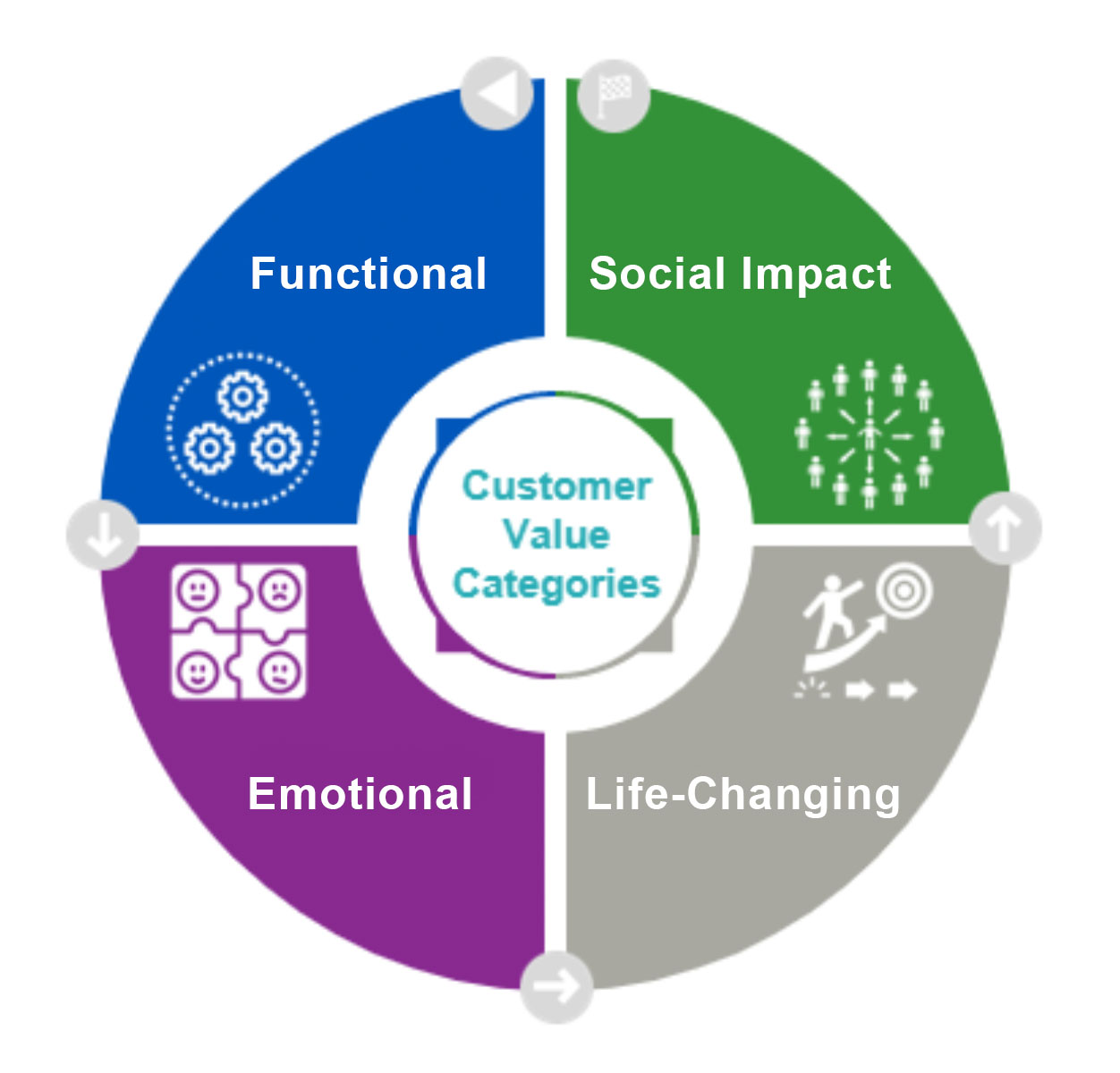
SIVO employs a 5-Step Process to develop your Customer Value Equation. In partnership with our client teams, we Mine, Explore and Quantify the customer value drivers leveraging Functional, Emotional, Life-Changing and Social Impact values. Note that the Quantify Step can be qualitative consumer learning, a quantitative survey or ideally, a combination of both. The design of this step is dependent on how much past learning that the team already has in hand.
Four Categories of Customer Value

We then partner with teams to Develop & Refine the Customer Value Equation. Lastly, we help teams Apply their equation by assessing where their products/services are over/under-delivering and facilitate them through the generation of ideas to improve the customer experience.
The result of our process is rich with discoveries. These insights provide a unifying understanding of the target customers’ purchase drivers, must-haves and nice-to-haves regarding a product or service – giving teams confidence and clarity on what to do with $1 more or $1 less.
Our Offer to You
SIVO is interested in sharing our Customer Value Equation experience and case studies with you and your insights team! Our “CVE Download” can easily be part of an in-person or virtual “Lunch & Learn” or your next team meeting.
If you can answer “yes” to at least one of the following three questions, please reach out to SIVO.
To learn more, contact us at Contact@SIVOInsights.com.
*Referenced article by Gautam Mahajan https://journals.sagepub.com/doi/full/10.1177/2394964320903557
Be consumer first. Don’t be consumer only. Powerful words by leading Insights executive, Khary Campbell, VP of Consumer Research & Insights at Comcast.
https://youtu.be/xJSQO7VSw5Q
During a recent SIVO Insights Forum, Khary shared the importance of considering the implications of all functions. After all, every function is working in orchestra of the business.
Click here for a lively on-demand conversation “Bridging The Gap: Translating Insights Into Meaningful Business Results" to hear from Khary and other Insights experts including Eliana Whanon (General Mills, VP of Consumer & Market Insights) and Elizabeth Oates (Book Author, and former Ulta Beauty VP of Consumer Insights.)
Learn from Insights leaders as they discuss:
Thank you to Natasha Weith, VP of Research at SIVO Inc. for hosting The SIVO Insights Forum!
In your brand's early development stages, you likely gave much thought to the idea of a buyer persona.
You researched who you expected to purchase your products, how they would interact with your brand, and which factors would influence them to choose your brand over a competitor's. You painted a picture of what their needs are, what they do, and how their key motivators would align with your offerings.
Now, it's time to see that journey in action.
The path to purchase describes the journey that your target buyers take from the moment they first discover your product or service until they ultimately decide to buy it. The better you understand this journey, the easier it is to connect with them at key milestones and decision points to convert them from awareness to consideration to purchase, and then to repeat purchases.
Today, we're sharing how to conduct this research effectively and what to do with the results you uncover.
Put simply, the path to purchase encompasses all of the steps that your users take as they convert from a prospect into a paying customer. This can include multiple different channels, touchpoints, and platforms.
While each person's brand experience will be nuanced and unique, most leads take a few central steps as they travel along this journey. These include:
Also known as a customer journey or buyer journey, the path to purchase can be a valuable part of your audience analysis. It allows you to climb inside the mind of your prospective buyers, and current buyers and understand why and how they're engaging with your brand.
Let's break these stages down a little, explaining the important aspects to research and analyze.
The first step in the path to purchase is awareness. This is the moment that your prospective customers first learn about your brand, and it sets the tone and the stage for the rest of your interactions together.
Years ago, mass marketing campaigns were more effective than they were today. Modern buyers want customization and personalization at every turn, and 80% are more likely to purchase from a brand that offers tailored experiences. This means that gone are the days when you could send out one e-mail blast or a generic postcard to your leads and expect them to convert.
Now, the most effective ways to reach your target audience include:
Not only should these outreach measures be personalized, but they should also include a call-to-action (CTA) that encourages users to take that next step. Do you want them to check out your website, sign up for your e-newsletter, contact you to set up a consultation? Remember to make the CTA clear, actionable, and easy to follow.
Once you've initiated the path to purchase, you can track your marketing efforts, e.g., engagement and response rate, to understand how effective your chosen tactics were. For instance, with inbound marketing campaigns, most website analytics platforms, such as Google Analytics, or CRM systems, such as, HubSpot, allow you to easily monitor the traffic going to your website, the number of views each blog gets, or the success rate of your paid online ads.
Regularly review these numbers to understand which channels are the most successful. Then, fine-tune the most profitable ones and look for ways to eliminate or phase out the ones that aren't as fruitful.
For larger brands with national distribution, you can also conduct advertising and brand awareness tracking research to understand the percentage of consumers who are aware of your advertising and brand, pre vs. post the execution of your marketing campaign or in regular intervals such as, one or two times per year.
Key questions to ask at this stage include:
Piquing the interest of your target buyer is only the first part of the path to purchase. Next, the prospect will consider all of the features that your company or product offers, comparing them against others in your same space. They're looking for differentiators that set your brand apart, such as price point, quality, speed of delivery, product features, and more.
To perform this competitive analysis, they may perform the following steps:
At the core of this step is the buyer's need for information and insights. If you can provide this intelligence about your solution better than anyone else can, then you're more likely to move them from this phase of the buyer journey to the next.
In this step, you'll need to research and manage your online presence and reputation. Do you know what your target buyers will see when they search for your brand name online?
There are reputation management tools that can help you uncover and respond to your company reviews. In addition to the reviews on your website or Google Business Profile, remember to also check common and industry-specific third-party review sites.
Another area to research is how well you've explained and demonstrated your product or service. If a prospective customer wanted to learn more about how your solution works, are there online descriptions, manuals, sheets, videos, or in-store signage that make this step simple? The more transparent you can be, the easier it is to compare your solution against another.
Key questions to ask at this stage include:
After a lead discovers and researches your brand, they may decide to take that next step and make a purchase. To help them get there, you'll need to provide information that reveals why your company or offering is the best fit for their needs.
Depending on the solution you offer, this could require the buyer to make a significant investment. They'll want to review all of their options and compare top features to make sure they're making a wise decision.
This final stage of the path to purchase is all about sealing the deal. Research your company's current methods for engaging prospects and moving them along the sales funnel.
Some companies with “Business to Business” (B2B) offerings might use this time to perform presentations, pitches, and demos to share how their products work. Others with “Business to Consumer” (B2C) offerings might use advertising, on-package claims, third-party endorsements and in-store signage to demonstrate their benefits to prospective buyers. . The nature of your business and the type of audience you serve will dictate the exact strategy you deploy.
Key questions to ask at this stage include:
At each stage of the consumer path to purchase, you'll have the opportunity to gather insights into buyer behaviors. As you do, it's important to know what metrics to track, when to dive in, and who to involve. Here are a few tips to help you make the most of the data you obtain.
As brands seek to improve their buyers’ path to purchase experience, most are focused primarily on hard numbers, aka quantitative data, about the purchase, including volume, amount and frequency of sales, who and where purchased, percent of repeat purchases, etc. While this type of behavioral data is extremely important -, but don't underestimate the value of qualitative insights about the buying journey.
The ultimate goal of each phase is to understand the mindset of your buyers, and you can't get there with quantitative measurements alone. You need to understand the emotions that your prospective buyers are feeling, as well as what's behind their concerns, hesitancies, and excitement.
A few of the ways you can capture qualitative feedback include:
Not only are these insights helpful in directing your current and future campaigns, but they can also motivate your internal stakeholders. If you can share direct quotes and client feedback with your C-suite and marketing teams, it's easier for them to understand the human side of their work, in addition to the technical and economical side.
For some B2C companies, there is a primary shopper involved in each brand interaction. However, most B2B transactions involve other, behind-the-scenes decision-makers and influencers.
As such, resist the temptation to consider the path to purchase as strictly linear and one-dimensional in nature. In reality, it's more multi-faceted and complex.
Try to learn about the key stakeholders involved in buying decisions, as well as their specific roles. It also helps to understand how they interact with one another, as well as when each one enters and leaves the buyer journey. While some will be involved from start to finish, others may join and leave at different times.
To get the fullest view of your path to purchase, don't start your research at the first time the buyer and seller interact. Instead, go back even further to the pre-shopping stage. Increasingly, this means analyzing how buyers live, work, and how they find and compare offerings to meet their needs.
Today, most buyers are hopping online to discover new brands. In fact, in the B2B sphere, the average customer performs 12 different searches before deciding to engage with a specific brand. While it can be difficult to pinpoint exactly when a buyer first discovers your brand, spend time exploring different purchasing triggers to understand how to optimize these interactions.
As you research and learn more about your customerpath to purchase, you can customize and fine-tune your offerings and marketing communications to appeal precisely to those who are interested in them the most.
At SIVO, we're dedicated to helping our clients understand their buyers' needs, beliefs, and behaviors. We can help you gain visibility and address challenges by asking the right questions directly to your target audiences. Then, we'll work with you to turn those insights into actionable steps that can drive conversions, improve engagement, and build brand reputation. Contact us at Contact@SIVOInsights.com or go to SIVOInsights.com today to schedule a discovery call and connect!
In the always-evolving landscape of consumer behavior, understanding the perceptions around how people feel about your brand, the reasons why they choose it and the context for how they use it can unlock future growth opportunities. For instance:
A proven consumer research methodology that stands out for gaining this type of foundational learning is the Attitude and Usage (A&U) study.
What is an Attitude and Usage study?
You can think of an Attitude and Usage study as delving deeply into the “who, what, where, why, when” of your brand and category. More specifically, this is a comprehensive research approach that often combines qualitative and quantitative techniques to uncover perceptions, preferences, motivations, and usage patterns of your (and your competitors’) consumer base. Because of the breadth it covers, the data collected, and insights gained become a foundational reference for Insights, R&D, and Marketing teams for many months or years afterward.
Attitude and Usage studies answer Key Objectives about:
Category Users: This involves understanding the basic demographic details of the users in your category (age, gender, income, etc.) alongside psychographic factors like values, beliefs, and lifestyle choices.
Consumer attitudes: You can fully understand consumer perceptions about the category, your brand, competitors, and the overall market. This helps you explain your market share, by gauging your brand’s “share of mind.” It reveals how your brand stacks up in consumers’ minds on important factors such as product quality, customer service, and other unique benefits, relative to the competition.
Usage Patterns: You can examine how consumers interact with your product or service, including frequency of use, when and where it is used, purchase motivations and delights/pain points. This context reveals insights that inspire ideas to improve the usage experience.
Trend Analysis: Although an A&U research study analyzes products or services at a point in time, it can be re-fielded at regular intervals so you can track changes in consumer attitudes and behaviors over time, to identify market shifts or emerging trends in the category. This is particularly useful in dynamic categories where there are always new competitors entering the market.
Benefits of an A&U for the Marketing and R&D Teams
Focused efforts on the “purchase funnel”: You will discover the percentage of your consumer target that is aware, has tried, is a repeat purchaser or is already loyal to your brand. Understanding this, relative to your competition, will help marketers decide where and how to spend their marketing support budget to drive sales effectively and efficiently.
Innovation and renovation ideas: Insights from A&U studies can fuel product improvements, innovations, and new launches that resonate with consumer desires, address usage pain points, and deliver on unmet needs.
Create a Competitive Advantage: Knowing where your products and services stand in comparison to the competition allows you to capitalize on your strengths and unique benefits by emphasizing via packaging claims and marketing messages. Identifying and addressing any shortcomings allows the team to close critical gaps that may be keeping you from gaining market share.
Long-Term Growth: Ongoing A&U research, in waves at regular intervals (depending on the level of activity in your industry or category) provides a pulse on evolving consumer and competitive trends, ensuring that your team can stay agile and responsive to changing market dynamics. This helps to foster and maintain growth over time.
Onboarding new employees: A bonus to having a comprehensive picture of the market dynamics and how your brand performs within the market is that it provides a great basis for onboarding new employees into your organization. It also paints a picture to get all employees aligned on growth strategies that are rooted in foundational market and consumer insights.
Your Partner for Actionable Consumer Insights
At SIVO, Inc., we are dedicated to helping our clients develop and utilize Attitude and Usage research to gain actionable insights that drive strategic decision-making and foster meaningful connections with consumers. By investing in A&U research, you and your team can navigate the complexities of the market with confidence and clarity, ultimately paving the way for long-term growth.
For more DIY approaches, check out SIVO’s On Demand Talent Profiles to learn more about how an experienced, fractional Consumer Insights Generalist can be also an asset for your A&U research needs.
Contact us via our website form or email us at Contact@SIVOInsights.com today to schedule a discovery call!
The great resignation took a major toll on businesses across industries in the last few years. Businesses that prided themselves in workplace culture, flexibility, and benefits saw long-time employees step down from their roles. At the same time, more and more companies face transformative restructuring, like acquisitions and mergers. Following such major changes in the world at large and within organizations, the opinions and beliefs held by workers changed tremendously, and even the most forward-thinking businesses have suffered the consequences.
With that, many businesses are looking for a path toward improving performance and commitment in the workplace. How can they avoid employee attrition in the future? How can they improve their processes to boost efficiency and support employees? How can they redirect leadership to provide the support those employees need? At the end of the day, organizational intelligence gets data-driven insights to answer all these questions, and much more.
First thing’s first, what is organizational behavior? Organizational behavior is how individuals interact and behave in groups. It’s especially relevant when looking at the workplace. Forward-thinking businesses take their organizational behavior seriously, because it greatly impacts employee satisfaction and engagement, leadership performance, and overall workplace efficiency and effectiveness. If organizations do not understand their employee behavior, perceptions and opinions, they miss out on insights that could holistically improve their business. The best way to get those opinions, and translate them into a strategic action plan is to leverage organizational intelligence solutions.
Who should gather organizational behavior data? Your team is full of subject matter experts on your business and your industry, but when it comes to gathering information on organizational behavior, they may not be the right facilitators. Internal teams will have natural bias and may have subconscious results in mind, and could therefore not ask appropriate, unbiased questions. Plus, when it comes to listening to your employees, you want to get thoughts from a wide range of team members. That means allocating the task to an outside expert, to increase cooperation by maintaining employee confidentiality. Ultimately, this gives every employee the opportunity to provide their opinions, maintaining employee anonymity while removing all potential bias from the initiative.

So, what are the keys to improving performance and commitment in the workplace? Understanding what motivates your team members is key to educating and empowering leadership to create a path toward a better future for your company. Get a breakdown on employee insights, leadership development, and strategic planning facilitation below:
What are the honest opinions of your employees when it comes to your business culture and processes? When leadership asks them directly, they will likely get a much different answer than an unbiased facilitator. However, there are many ways to gather this information from your team. An organizational intelligence expert can identify a custom learning plan based on your business, and implement solutions designed to get the most valuable feedback from employees. According to the Harvard Business Review,
“High-OQ (organizational intelligence) leaders foster an understanding, or ethos, of “who we are.” When leaders move from managing individuals or small groups to leading entire organizations, they need to create a shared understanding of what’s important and what the organization stands for — in other words, an ethos.”
What kind of exercises result in the best employee insights? This varies depending on the organization, but typically it comes down to both qualitative and quantitative research. Some examples of qualitative research include one-on-one interviews, small group employee discussions, and stakeholder interviews. Meanwhile quantitative research looks more like customized online employee engagement surveys targeted to specific employee teams, departments, functions, and regions. Often, employee engagement surveys are administered with regular frequency, e.g., annually or bi-annually, to measure positive or negative changes in employee satisfaction and engagement over time.
Your industry is constantly changing, your business is growing, and workplace expectations are ever-evolving. Is your leadership adapting to accommodate? Modern businesses must create an expectation for agility in leadership to keep employees engaged and motivated. That means regular leadership training, coaching, and development. Organizational intelligence experts can handle the task and provide tailored, relevant coaching that meets the needs of your leaders. It begins with one-on-one introductory sessions, a 360 degree leadership assessment and follow-up analysis, development planning and coaching sessions with leaders at all levels of the organization - executives, high-potential leaders, and new managers. This results in more effective leadership and impactful business management that can exceed the expectations of their teams.
What solutions are involved in leadership development? First, there is leader coaching and education, which can include leadership assessments, feedback, and career planning directly with leaders. This can take place individually or in group/cohort sessions. There is also team effectiveness training, which helps teams define their purpose, processes, roles and responsibilities, as well as individual contributions. This is especially important for businesses facing restructuring, where new teams are being formed and leadership responsibilities are changing.

You have so many initiatives in the works – strategic planning can feel like one of those tasks that could easily get pushed down the line. However, strategic planning is the high-level exercise that impacts every other element of your organization. Outsourcing guarantees timely and effective execution, especially when you pick the right partner for the job. Market research firms like SIVO offer comprehensive workshops to ensure your team develops a sound strategic plan that will successfully lead the company into the future.
These facilitated workshops are especially beneficial to newer businesses or businesses facing large changes, like acquisitions, mergers or a challenging external environment. Knowing how to bring teams together, leveraging critical and inspirational inputs is no small task. That’s why it’s beneficial to have experienced strategic planning facilitators on your side, to plan and facilitate the workshop so that you leave the session with a clearly defined vision, mission, values, plans and ownership assignments. Sessions may also focus on other topics, such as communications planning, insight activation sessions, special-interest group planning, and even competitive SWOT analysis. Regardless of the focus, each strategic planning session will help leaders develop and align on clear strategies for the future, to drive business success.
No matter the business, every employee wants to be heard. Creating a place for employees to provide their thoughts can only benefit your business. From an employee perspective, these people-focused exercises prove that leadership cares about their opinions and wants to make steps to improve their workplace experience. The same goes for dedicated strategic planning exercises and leadership development. These initiatives create a stronger, people-first organization positioned to succeed. When leaders are effective, employees are motivated, and business strategy is in place, it all adds up to improved performance and commitment in the workplace – and more success in the market.
Organizational intelligence services result in game-changing insights that can transform your business for the better – and position you for even more growth down the line. Your team members have the deep knowledge about the company and industry, and often, their perspectives can unlock opportunities that leadership would have never otherwise considered. Once those insights are relayed to leaders with actionable recommendations, you can accomplish so much more within your organization.
Are you ready to gain insights on your organizational behavior? Get information on every aspect of your organizational behavior with SIVO. Our team of organizational intelligence experts can help you lead your team through any major transition. We work with organizations across industries, and build custom insight solutions that holistically improve performance and commitment in the workplace.
Contact SIVO today to discuss your business needs and get support.
SIVO Insights brings together research, talent, and intelligent technology to help organizations navigate complexity with confidence. Have a business challenge? Let's talk!
We bring together research, talent, and intelligent technology to help organizations navigate complexity with confidence